After several years of inflated budgets propped up by trillions in unsustainable COVID cash flowing to the states from the federal government, Arizona lawmakers will be coming into the new year and the new legislative session facing a potential shortfall for the budget year in excess of $400 million. Naturally, the left and their sycophants in the media have for months been decrying this to be the result of 1) historic tax cuts enacted by Republicans in 2021 and 2) the successful universal expansion of school choice in 2022. This couldn’t be further from the truth, and there are three key facts that need to be remembered when discussing the state budget and a potential funding gap.
1. The Shortfall Is a Fraction of the Arizona Budget, Nothing Like California’s Crisis
The projected $400 million shortfall represents less than 5% of the total state budget, which spends $17.8 billion this year. Far from catastrophic. Compare this to our neighbor California, facing a $68 billion dollar deficit (nearly four times the size of our entire budget), which represents 22% of their $308 billion bloated budget – up from less than $200 billion only four years ago.
Opposite to our approach, California has continuously increased taxes, having one of the highest income tax burdens in the country. They also don’t provide choice to parents and families to make educational decisions themselves. Surely, if Arizona taking less of the people’s hard-earned money and providing ESAs to all families is the cause of our small funding gap, California, doing the exact opposite, should place them in tip top shape, right?
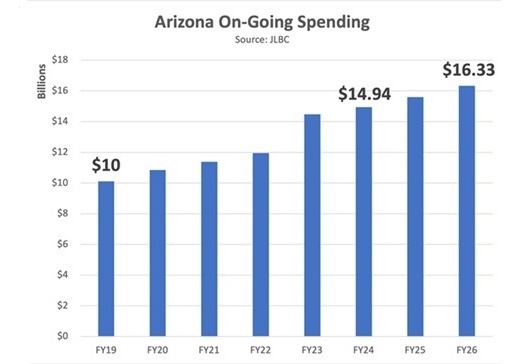
2. State Revenues Continue to Rise, but Spending Does Too
Contrary to the wishes of the tax happy left, this small budget shortfall is not due to the historic tax cuts passed in 2021 that benefit every Arizonan either. The state is collecting more from taxpayers than it did in 2019, yet the income tax rate has effectively been cut in half. Part of that is due to the taxation of online sales. Initially sold to be an $85 million hit on taxpayers, it continues to bring in hundreds of millions more. The other more inconvenient reason for the left is the thousands fleeing high tax states like California to relocate themselves, their families, and their businesses here.
Source: JLBC FY2020 Appropriations Report & JLBC October Budget Forecast
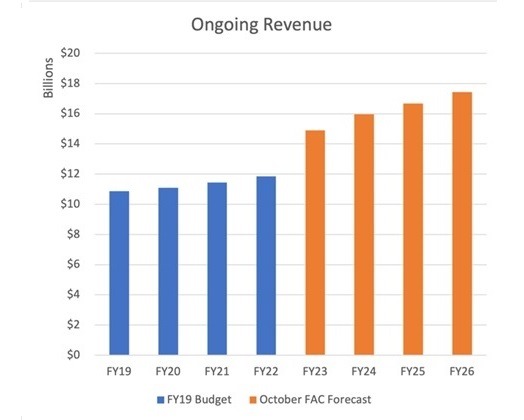
This “lack of money in the state coffers” argument is laughable with one quick look at the Ongoing Revenue chart. In summary, lawmakers enacted a budget in 2019 that expected just shy of $11 billion in ongoing revenue. In their best assessment, they expected that to grow to nearly $12 billion by FY22 (blue). But what we have experienced since then (orange) is exponential revenue growth – growth that is still continuing today. In fact, the most recent estimate from the nonpartisan Joint Legislative Budget Committee (JLBC) staff is still close to $18 billion in state revenue by 2026. We do not have a revenue problem, and we never did. Rather, we have had a spending problem for years.
3. School Choice Not to Blame, and Government Schools Are at Record Levels of Funding
Unsurprisingly, the teachers’ unions, Democrats, and media continue their scare tactics, arguing that the massive increase in families taking advantage of their right to send their kids to the schools of their choice, is bankrupting the state and government schools. It’s no surprise that neither are true.
As the Goldwater Institute has made clear, increased use of ESAs does not take from district schools. In fact, district schools are receiving $14,673 per student, an amount never reached before, which has required the legislature to override the constitutional spending limit not once, not twice, but three times, allowing schools to spend billions in excess of the cap.
That ESAs are to blame for the shortfall is also easily debunked by simply looking at JLBC’s presentation to the Finance Advisory Committee in October. In the budget approved by the legislature and the Governor, ESA expenditures were projected to be $625 million. The actual amount is $665 million, not very far off at all. In other words, the projections made by lawmakers in July were accurate and fully budgeted for.
Budgeting Guidelines to Avoid Fiscal Failures
The big picture is that states across the country are seeing slowdowns in revenue growth and potential shortfalls, especially in personal income tax collections. That includes states that have reduced rates (like us), and those that have hiked theirs (like California). But unlike many of those high tax states, Arizona is in a good position.
As long as the legislature: 1) doesn’t allow Hobbs to use any budget gimmicks like rollovers, 2) doesn’t touch the rainy-day fund, and 3) uses this as an opportunity to right size government spending, we will be just fine.
Help Protect Freedom in Arizona by Joining Our Grassroots Network
Arizona needs to have a unified voice promoting economic freedom and prosperity, and the Free Enterprise Club is committed to making that happen. But we can’t do it alone. We need YOU!
Join our FREE Grassroots Action List to stay up to date on the latest battles against big government and how YOU can help influence crucial bills at the Arizona State Legislature.
Ozone levels in Maricopa County are lower today than they were 20 years ago. And the reality is that most of the ozone currently in the region is either due to natural events or coming from China. But you won’t hear facts like that from the Left. Instead, they’d rather hatch a scheme to enforce their climate change agenda on the American people, and one of their biggest targets in the past year has been Arizona. Now, after failing to convince our state to ban gas cars and gas stoves, the Sierra Club is attempting to use the courts to force this agenda upon us.
An Impossible Standard
Much of this began in September 2022 when the United States Environmental Protection Agency (EPA) reclassified Maricopa County as a moderate nonattainment area of ozone limits under the Clean Air Act. This basically means that, according to the EPA, Maricopa County’s ozone levels are too high and therefore our state—including its citizens, motorists, and businesses—must be forced to adopt ozone control measures. Failure to comply with these measures could mean fines, penalties, or the withholding of federal transportation dollars for Arizona.
Of course, what they won’t tell you is that the main reason our ozone levels are too high isn’t because there are more cars on the road or Arizonans like trying new recipes on their gas stoves. The main reason our ozone levels are too high is because the federal government moved the goal posts back in 2015 when the EPA dropped its acceptable ozone levels from 75ppb to 70ppb.
To the average person, that may not seem like a big deal, but it is. In fact, in order to achieve the EPA’s standard by the August 3, 2024 deadline, Arizona would need to cut emissions by 50 percent. This is not only impossible, it’s absurd. It took our state over 23 years to reduce ozone pollution by 12.5 percent. There’s absolutely no way we could cut it by 50 percent in a year! But since the Maricopa Association of Governments (MAG) has become another puppet for the Left’s climate agenda, its plan fell right in line with its EPA masters.
Stopping MAG’s Green New Deal Plan
Along with a host of regulations on various business activities, MAG’s Green New Deal Implementation plan was filled with restrictions that would make AOC blush. It included:
Eliminating gas-powered cars.
Eliminating gas appliances.
Limits on things like lawn equipment, motorized boating, and water heaters.
Regulations on the commercial trucking industry that we rely on for supplies and goods.
Arizona could implement every one of these destructive measures, and we still wouldn’t come close to achieving the EPA’s ozone standard—especially by that deadline. In the meantime, our state would have been forced to suffer billions of dollars in economic damage all while watching our quality of life go down the tubes.
That’s why the Free Enterprise Club spent several months fighting back against MAG’s plan. And that proved to be a success. In June of this year, MAG abandoned its plan and instead sent a letter to the EPA that essentially adopted our position. It mentioned the challenges related to timing, the overwhelming contribution of ozone from outside sources, and the economic consequences we would face with such harsh ozone regulations. These are reasonable arguments that should be enough for the EPA to reconsider its standards, but the response from the Left was…a lawsuit.
The Sierra Club Sues to Force Arizona to Achieve the Impossible
In October, the liberal non-profit Sierra Club decided to sue the Biden administration to increase regulatory oversight of several states, including Arizona. And their goal is clear. They either want to get a liberal judge to force our state to implement California-style control measures, or they want to collude with the EPA to do a “sue and settle” and enter into a consent decree that does the same.
But what the Sierra Club intentionally ignores is that you could take all 4 million cars off the road in Maricopa County, and Arizona still couldn’t achieve the EPA’s impossible standards. Just look at what happened in 2020 during the COVID-19 pandemic. Ozone levels increased from 79ppb to 87ppb even though we saw a dramatic decrease in cars on our roads.
You would think that would be enough to recognize that these measures won’t work. Or maybe, just maybe…the Sierra Club’s agenda isn’t really about ozone in the first place. That’s why the Club plans to fight back against this lawsuit and any other way that the Sierra Club is trying to force the Green New Deal on our state. The measures they are pushing are coercive, punitive, and likely illegal. And the people of Arizona shouldn’t have to sacrifice their freedoms so the Left can turn us into another California.
Help Protect Freedom in Arizona by Joining Our Grassroots Network
Arizona needs to have a unified voice promoting economic freedom and prosperity, and the Free Enterprise Club is committed to making that happen. But we can’t do it alone. We need YOU!
Join our FREE Grassroots Action List to stay up to date on the latest battles against big government and how YOU can help influence crucial bills at the Arizona State Legislature.
It’s time for COVID mandates to go away forever. And last month, one Arizona town took a step in this direction when it passed a resolution that needs to be a trend in every city throughout our state.
With a desire to take proactive measures to protect citizens’ constitutional rights, the Queen Creek Town Council passed Resolution No. 1540-23 with a unanimous vote during its regular meeting in September. And it’s quite clear. While the town recommends that people exercise personal responsibility to prevent illness, it committed to not implementing mandates concerning masks, vaccines, business closures, curfews, or “any similar measure.”
On top of that, the new town policy protects its employees who will be allowed to make their own decisions on vaccines and mask-wearing without facing the threat of losing their jobs for refusing to wear a mask or get the COVID vaccine. And perhaps even better, the new ordinance doesn’t just apply to COVID. It has been officially adopted by the town for the response to any future pandemic. It’s about time we see some sanity in government.
While it’s certainly sad that it ever had to come to this, COVID paranoia has been with us for several years now, and it’s clear that it’s not going away any time soon. Back in August, Morris Brown College in Atlanta implemented a two-week mask mandate for all students faculty and staff. And in the same month, Hollywood studio Lionsgate also instituted a mask mandate for employees due to COVID. Yes. This is still happening in August 2023.
But it also serves as a great reminder of all the ways government officials seized our freedoms during the pandemic.
We faced mask mandates, lockdowns, and social distancing all in the name of taking “15 days to slow the spread.” Many students were shut out of their classrooms for over a year only to find out that the Centers for Disease Control and Prevention (CDC) was following the advice of a teachers’ union. Some government officials threatened the idea of vaccine passports as the price of getting back to normal. Then, President Biden took it a step further when he went ahead and mandated vaccines for any employer with 100 or more employees with cities like Phoenix following in his footsteps. While the Supreme Court eventually blocked the move, many citizens had already given in to the mandate out of fear of losing their jobs, and the damage had been done.
But let’s take a step back to June 2020. If you’ll recall at that time, just about every local government in the state of Arizona enforced mask mandates. That included Phoenix, Tucson, Flagstaff, Mesa, Gilbert, Chandler, Scottsdale, Tempe, and more. But one town refused to implement mask mandates any longer. And that was Queen Creek.
Now, the town is leading the charge toward freedom again, and it’s time for the rest of Arizona’s cities to get on board. COVID hysteria has gone on long enough. And the Club is committed to doing whatever it takes to ensure that a great ordinance like the one Queen Creek just passed is spread around the entire state.
Help Protect Freedom in Arizona by Joining Our Grassroots Network
Arizona needs to have a unified voice promoting economic freedom and prosperity, and the Free Enterprise Club is committed to making that happen. But we can’t do it alone. We need YOU!
Join our FREE Grassroots Action List to stay up to date on the latest battles against big government and how YOU can help influence crucial bills at the Arizona State Legislature.
For local governments—and councils of governments—in Arizona, it appears that creating a climate action plan has become all the rage. Maybe that’s because it pays well.
The latest group to bow down at the altar of the Biden administration’s climate change agenda is the Maricopa Association of Governments (MAG). Back in August, MAG received a $1 million grant from the Environmental Protection Agency’s (EPA) Climate Pollution Reduction Grant Program to serve as the lead planning organization for the Phoenix-Mesa-Chandler metro area. The grant requires MAG to develop a priority climate action plan by next March, a comprehensive climate action plan by 2025, and a status report in 2027 after the four-year grant period expires.
But this $1 million grant isn’t the only way MAG stands to benefit.
The development of a priority climate action plan is simply a prerequisite for phase two of the EPA’s grant program, which concerns implementation grants for greenhouse gas emissions reduction policies, programs, and projects. And that could lead to MAG overseeing up to $4.6 billion in federal funding. Now, we see the true motivation.
All of this builds off what governments in Tucson, Tempe, and Phoenix have already passed in their respective cities. Earlier this year, the city of Tucson finalized its climate action plan to the tune of $326 million. And it’s ripe with Green New Deal mandates that are aimed at controlling citizens’ lives, forcing them out of their cars, and destroying the community.
Then, there’s the Tempe City Council which claims to have created a road map to address the immediate threat of “extreme heat.” As part of its plan, the city will be implementing green codes and standards that it believes will create a more walkable and cooler Tempe. Maybe someone should tell the Tempe City Council that we live in a desert and the so-called “extreme heat” they think they can control has always been a normal part of Arizona summers.
Of course, we can’t forget about Phoenix, where Rep. Ruben Gallego has also jumped on the “extreme heat” bandwagon by lobbying for more federal dollars to counter it. And Mayor Kate Gallego has urged the Biden administration to declare Arizona’s heat a federal emergency to, you guessed it, grab more federal funding. The City of Phoenix passed its climate action plan in 2021 with a goal to reduce emissions by 50 percent by 2030 and achieve net-zero emissions by 2050. Keep in mind that this is the same Phoenix that implemented “cool” pavement that is making people hotter and wants to eliminate parking spaces in an effort to become a 15-minute city. And on top of that, its current mayor is helping to lead a globalist effort to ban meat, dairy, and private cars by 2030.
This is the agenda MAG has chosen to join. Now, with this grant, it will be actively working with the rest of the cities in Maricopa County to adopt climate action plans just like these. And with that, MAG has made its true motivations clear. It is nothing more than a puppet for the Biden administration and the Left.
Help Protect Freedom in Arizona by Joining Our Grassroots Network
Arizona needs to have a unified voice promoting economic freedom and prosperity, and the Free Enterprise Club is committed to making that happen. But we can’t do it alone. We need YOU!
Join our FREE Grassroots Action List to stay up to date on the latest battles against big government and how YOU can help influence crucial bills at the Arizona State Legislature.
The Arizona Free Enterprise Club is proud to release our 2023 Legislative Scorecard. Over the course of the 2023 legislative session, the Club tracked and engaged on more than 60 bills, resulting in more than 35,000 emails sent to lawmakers from nearly 15,000 activists across the state. Our 2023 scorecard (View House Scorecard and Senate Scorecard) includes votes taken on 25 bills in the House and 30 bills in the Senate that cover priority issues for the Club and grassroots conservatives.
This year presented a unique challenge. For most of the legislative session, the caucuses in the House and Senate were unified, and there was less bad policy that made it onto the floor for a vote in either chamber. That’s a good thing, but it does make it difficult to distinguish the views of members when there are fewer contentious votes. There were, however, a few key difference-making votes.
For example, the Club has long opposed refundable tax credits for corporations, and similar to previous sessions, this year the Senate voted on SB1562, increasing the refundability for a portion of the program and making the other portion of the existing nonrefundable R&D tax credit refundable. You can find out more about why we oppose this idea here. Additionally, the House Appropriations Committee voted to increase and extend the Club opposed Low Income Housing Tax Credit program, which you can learn more about here. Most impactful, however, was a Prop 400 plan opposed by the Club and supported by MAG that was passed the last day of session as SB1102. These bills had the largest influence on lowering scores in both chambers.
We also scored dozens of bills supported by the Club. This includes bills to strengthen the integrity of our elections, cut taxes, and protect children from sexually explicit materials, and referrals to the 2024 ballot that will limit the power granted to the Governor during a state of emergency (HCR2039), protect our primary elections (HCR2033), and protect our ballot against initiatives bankrolled by out of state special interests to put liberal policies on the ballot (SCR1015).
A full list of bills scored in this year’s scorecard can be found here, and the full methodology, including the weighting of each bill, for the House can be found here and for the Senate can be found here.
Given the rigorous criteria in the Club’s 2023 and past years’ scorecards, the top performing legislators distinguished themselves as faithful conservatives in the caucus. These members consistently fight for limited government, free market principles, low, smart, and fair taxes, and individual liberties. The Club Top performers in the Legislature who have earned a lifetime ‘A’ in 2023 included:
Representative Neal Carter (LD15)
Representative Joseph Chaplik (LD3)
Representative Justin Heap (LD10)
Representative Laurin Hendrix (LD14)
Representative Rachel Jones (LD17)
Representative Alex Kolodin (LD3)
Representative David Marshall (LD7)
Representative Cory McGarr (LD17)
Representative Steve Montenegro (LD29)
Representative Barbara Parker (LD10)
Representative Jacqueline Parker (LD15)
Representative Michelle Peña (LD23)
Representative Austin Smith (LD29)
Representative Beverly Pingerelli (LD28)
Representative Travis Grantham (LD14)
Representative Gail Griffin (LD19)
Senator Jake Hoffman (LD15)
Senator Anthony Kern (LD27)
Senator Janae Shamp (LD29)
Senator Justine Wadsack (LD17)
Senator Warren Petersen (LD14)
Senator JD Mesnard (LD13)
Senator Wendy Rogers (LD7)
You can view the 2023 Legislative Scorecard for the House here.
You can view the 2023 Legislative Scorecard for the Senate here.
Help Protect Freedom in Arizona by Joining Our Grassroots Network
Arizona needs to have a unified voice promoting economic freedom and prosperity, and the Free Enterprise Club is committed to making that happen. But we can’t do it alone. We need YOU!
Join our FREE Grassroots Action List to stay up to date on the latest battles against big government and how YOU can help influence crucial bills at the Arizona State Legislature.
How much do you like to walk in 110-degree heat? If you’re a resident of the city of Phoenix, you may need to start getting used to it if the city council gets its way.
A proposed ordinance in Phoenix is looking to significantly reduce the minimum number of parking spaces it requires for apartments. Currently, Phoenix requires a minimum of 150 parking spaces for every 100 one or two-bedroom apartments. Under the proposed ordinance, that number would decrease to 125 spaces. But that’s not the end of it. For new affordable apartment complexes near light rail stations, the requirement for most would be reduced to zero! Yes. Zero parking spaces at an apartment complex. Have you caught on to their agenda yet?
If you’ve been keeping score, you already know that—in just this year—climate change zealots have been seeking to prohibit gas stoves; put limits on things like lawn and garden equipment, motorized boating, and water heaters; and ban the internal combustion engine. Now, this latest attempt to reduce parking spaces makes it clear. They want to force you out of your air-conditioned car to walk in 110-degree heat with your reward being to wait for a bus or light rail—all the while hoping that you don’t develop heat stroke. Then, once you’re riding on whatever form of public transit you’ve been forced to use, you get to hope that you won’t be assaulted or victimized on a system of transportation that’s seeing an increase in crime. Finally, you’ll get off said public transit and be rewarded with yet another long walk in 110-degree heat. (But at least it’s on Phoenix’s “cool” pavement. Oh wait. It turns out, that’s making people feel even hotter.)
Remember when they said, “You’ll own nothing, and you’ll be happy”? They’re certainly doing everything they can to make the first part a reality. But there isn’t a soul in Phoenix who would be happy walking around the city during an afternoon in July.
All this nonsense is aimed at their agenda to turn Phoenix into a 15-minute city, and they’re not even trying to hide it anymore. Case in point, meet Phoenix’s Vice Mayor Yassamin Ansari who recently took to Twitter to hype the proposed ordinance and the 15-minute city concept—where cars will be phased out and everything you need will supposedly be available by foot, bike, or public transit. Of course, if Ms. Ansari is so passionate about Phoenix becoming a 15-minute city, perhaps she’d be willing to lead by example. Why doesn’t she give up her car, walk to the bus stop every day in 110-degree heat, and ride the public transit that she believes is so safe?
But she won’t. And none of the liberal elites pushing this plan will either. They will continue to use their own car and park in their premium parking spots while all of us regular folks are left to deal with these outrageous policies.
They hate how we live and how we get around, and now they want to make us miserable until we surrender to their climate change agenda. But with the proposed parking plan up for a vote sometime in September, there’s still time to fight back. Stay informed. Build a passionate argument based on facts. And make your voice heard. Tucson residents recently defeated a similar attempt to create a 15-minute city by voting down Prop 412. Now, Phoenix should follow their lead.
Help Protect Freedom in Arizona by Joining Our Grassroots Network
Arizona needs to have a unified voice promoting economic freedom and prosperity, and the Free Enterprise Club is committed to making that happen. But we can’t do it alone. We need YOU!
Join our FREE Grassroots Action List to stay up to date on the latest battles against big government and how YOU can help influence crucial bills at the Arizona State Legislature.
Recent Comments