Unions are in decline in America, and it’s no surprise as to why. Most do not offer any sort of value to the overwhelming majority of workers.
You would think they could take a hint. In 2017, workers at Nissan in Mississippi and Boeing in South Carolina rejected union representation by a wide margin. In 2019, Volkswagen employees in Tennessee voted against unionizing for the second time in recent years. And just last month, employees at an Amazon facility in Alabama largely rejected joining the Retail, Wholesale, and Department Store Union.
So, what solution has labor unions come up with? Will they focus on bringing more value to members or potential members? Will their leadership stop supporting liberal and other far-left causes? Will they stop pushing socialist policies and politicians?
Nope. Their solution is to force American workers to join unions through legislation.
H.R. 842, also known as the Protecting the Right to Organize (PRO) Act, would enact sweeping changes to the National Labor Relations Act. And it’s dangerous in 3 particular ways.
The PRO Act repeals all state right-to-work laws.
Currently, 27 states have right-to-work laws, including Arizona. These laws ensure workers can choose whether or not to join a union and pay for representation. The PRO Act would remove these laws, which could cause some workers to lose more of their wages and others to lose their jobs.
The PRO Act ends the secret ballot for unionization votes.
Secret ballots protect workers from being intimidated into joining a union. And in Arizona, we put a right to secret ballot in our state constitution more than ten years ago. But now, the PRO Act puts that in jeopardy, opening up workers to threats, misrepresentation, and other false promises from unions.
The PRO Act makes independent contracting nearly impossible.
When you’re thinking about state laws to mimic, California is probably not a state that comes to mind. And yet, the PRO Act would take California’s disastrous Assembly Bill 5 (AB5) nationwide. This so-called “Pro-Worker Law” has already killed jobs left and right in California. And now, it threatens freelancers across the country who want flexibility and like being their own boss.
Clearly, the PRO Act is nothing more than a giveaway by congressional Democrats to union bosses to help them boost their declining membership rolls. So, it’s no surprise that the Democrat-controlled House already passed the bill back in March. And President Biden, the most pro-union president ever, is itching to sign it.
But right now, its fate rests in the Senate. And a coalition of liberal organizations and unions are spending big money around the country, especially here in Arizona, to make sure it’s passed. They know that Arizona Senators Kyrsten Sinema and Mark Kelly likely hold the key to making that a reality. After all, they are among only three Democrats who did not co-sponsor the bill.
That’s why it’s critical for you to take action today! Contact Senator Sinema and Senator Kelly right now and tell them to vote NO on the dangerous PRO Act (H.R. 842). The future of workers rights and our economy could depend on it.
Take Action
Tell Senators Sinema and Kelly to vote NO on the Dangerous PRO Act (H.R. 842) and save our Economy!
When government enjoys a surplus, three options are available. They can either spend it, save it, or return it to taxpayers. Arizona has already checked off the first two options—increasing spending and amounting a billion-dollar rainy day fund. With a staggering surplus totaling $6.5 billion by FY2024, the answer this year must be returning money to taxpayers.
Though many factors have contributed to this record high state surplus, one huge contributor is undoubtedly new taxes Arizonans have shouldered over the past several years.
In 2018, the legislature handed taxing authority over to the Director of Transportation. Originally sold as a new $18 “Highway Safety Fee” to fund DPS, when implemented the fee was levied at $32 per registration—an annual $185 million tax hike. And the funds weren’t even used for public safety as promised—they were swept into the general fund and used to pay for other projects.
A groundswell of angry Arizona taxpayers bombarded the legislature with phone calls and emails, and many supporters of the fee quickly became vocal opponents. The fee was repealed by the Legislature a year later, but not until over $500 million will be paid by vehicle owners before its final phase-out this summer.
And in 2019, following the Wayfair Supreme Court decision, Arizona enacted legislation allowing for the collection of TPT from remote sellers and marketplace facilitators. Initially scored as an ongoing $85 million increase in revenue, collections from Wayfair have brought in over $425 million in state and local collections so far in FY2021 according to research provided by the Arizona Tax Research Association. That’s nearly a half billion dollars in taxes Arizonans previously were not paying on their online purchases.
Additionally in 2019, in an honest effort to offset increased revenues from conforming to the federal tax code, the Legislature made cuts to individual income tax rates. However, the estimate used to determine these cuts ended up being far too small, and Arizona taxpayers shouldered a $100-200 million income tax increase as a result.
But all of this wasn’t enough. On a slim margin in 2020, voters approved Prop 208 which is set to propel Arizona into the 9th highest income tax rate in the nation and 2nd only to California when looking at western states. This is nearly a billion-dollar tax hike, a third of which is carried on the backs of small businesses.
With the exception of Prop 208, which will push small businesses and new investments away from Arizona potentially decreasing state and local revenue, the other tax increases have been to the benefit of the state general fund and a windfall for cities.
Yet as if these windfalls and a growing economy weren’t enough, cities raised taxes on their residents too. In 2017, Payson increased their TPT rate from 2.12% to 3%. In 2017, Tucson raised its TPT rate from 2% to 2.5% followed a year later by another increase to 2.6%. In 2019, Flagstaff raised its TPT from 2% to 2.281%. Between property taxes and TPT, the same story can be seen across the state.
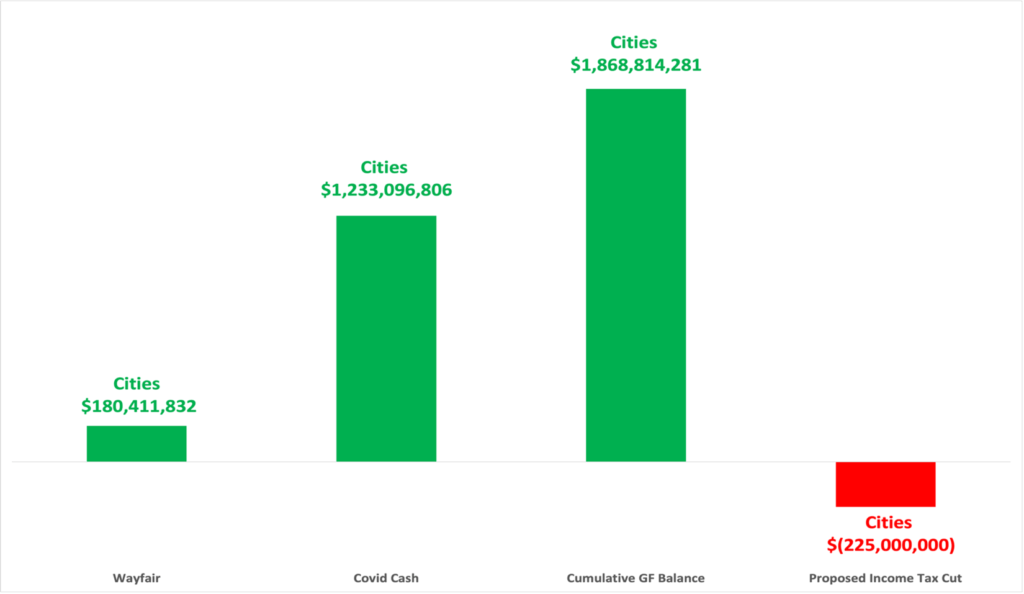
When cities have been faced with increased revenue on the backs of taxpayers, their response has been to increase spending and increase taxes. All the while sitting comfortably on cumulative General Fund balances exceeding $1.8 billion.
Any “loss” in revenue cities see as a result of tax cuts being discussed in the Legislature must be in context to the billions in new taxes, tax increases, and fees that have been footed by taxpayers for years and resulted in windfall after windfall for cities. The time to act is now, and Arizona taxpayers deserve to have their money returned.
Help Protect Freedom in Arizona by Joining Our Grassroots Network
Arizona needs to have a unified voice promoting economic freedom and prosperity, and the Free Enterprise Club is committed to making that happen. But we can’t do it alone. We need YOU!
Join our FREE Grassroots Action List to stay up to date on the latest battles against big government and how YOU can help influence crucial bills at the Arizona State Legislature.
This was all supposed to be based on “science.” Or so claimed groups like the Centers for Disease Control and Prevention (CDC) for over a year now. It was the rationale for the draconian lockdowns. It was the reasoning behind the overreaching mask mandates. And whenever the topic of schools reopening arose, we were told that students couldn’t return to in-person learning yet because “science.”
Then, on February 12, President Biden issued a statement declaring that opening most K-8 schools by the end of his first 100 days was a national imperative. That sounds good enough, but this announcement came with a catch. President Biden said that this could “only be achieved if Congress provides states and communities with the resources they need to get it done safely through the American Rescue Plan.”
But the president didn’t stop at shamelessly pushing his disastrous $1.9 trillion “COVID relief bill” that’s jam-packed with far-left policies unrelated to the pandemic. He went on to praise the CDC as providing “the best available scientific evidence on how to reopen schools safely.”
Yesterday, top Republicans on the House Energy and Commerce Committee sent a letter to Dr. Walensky demanding answers. But she has yet to respond. Meanwhile, AFT President Weingarten posted a desperate and ridiculous series of tweets attempting to rationalize the union’s behavior as “routine.”
But since when is it routine for the CDC to copy and paste nearly verbatim guidance from a teachers’ union? If this is a common practice, then everyone at the CDC should be fired immediately.
The fact is that many students haven’t been missing out on just in-person learning. They’ve been missing out on learning altogether—with one report estimating up to 3 million students across the country who haven’t experienced any formal education since March 2020.
You would think that an “American Federation of Teachers” would care about these students and their parents. But the AFT doesn’t. It only cares about protecting its own interests. And the only science the CDC is interested in…is political.
Help Protect Freedom in Arizona by Joining Our Grassroots Network
Arizona needs to have a unified voice promoting economic freedom and prosperity, and the Free Enterprise Club is committed to making that happen. But we can’t do it alone. We need YOU!
Join our FREE Grassroots Action List to stay up to date on the latest battles against big government and how YOU can help influence crucial bills at the Arizona State Legislature.
They’re at it again. You would think that public school districts would learn their lesson at some point. After all, many of them turned their backs on students and parents in the wake of COVID-19. And now, those school districts are paying the price.
But apparently, they’re too committed to their agenda.
Some school districts are ignoring the science and keeping their beloved mask mandates. Some would rather keep parents in the dark about classroom curriculum. While others are trying to adopt Marxist Critical Race Theory programs in their schools.
The latest culprit is Litchfield Elementary School District, where the school board recently published an “equity statement” along with a set of “equity goals.” The goals were presented at the school board meeting in March and crafted by, you guessed it, a “district diversity committee.”
If you’re unfamiliar with Critical Race Theory, it’s a movement that combines Marxist theories of class conflict within the lens of race. And it teaches that racism is present in every interaction. Races that have been “minoritized” are considered oppressed while those who are “racially privileged” are called “exploiters.” Proponents of the movement are good at disguising it. As Christopher Rufo from the Manhattan Institute points out, you’ll often find Critical Race Theory is present when you hear terms like “social justice,” “diversity,” “inclusion,” and “equity.”
Sound familiar?
Litchfield’s Superintendent Jodi Gunning claims that her school district is not adopting Critical Race Theory, but just read the first sentence of her letter to all district families:
I’m writing to update you about Litchfield Elementary School District’s diversity, equity, and inclusion (DEI) work…
All the evidence is there. Thankfully, parents and other taxpayers are starting to raise their voices, causing one Litchfield board member to respond to criticism of the district’s “equity statement” inappropriately.
Sadly, this is nothing new. Activists have been trying to force Critical Race Theory or similar programs into our schools for quite some time. In fact, back in 2019, Chandler Unified School District adopted a program called “Deep Equity” (there’s that word again) at nearly half a million dollars! (It’s amazing the moments when capitalism becomes acceptable.) Parents spoke out back then, and the program was soon phased out.
But that doesn’t mean liberal educators and other members of the left won’t try again. That’s why we must remain vigilant. One way to do so is by appealing to state lawmakers. Arizona should look to follow the lead of states like Texas, where a ban on Critical Race Theory recently passed out of committee in the House, and Idaho, where a bill to ban it was just sent to the governor.
But legislative work alone can’t be enough. It is critical in the world we live in today for parents to stay informed, talk to their children, and speak up when this sort of curriculum tries to sneak its way into classrooms. There is strength in numbers. And that’s where taxpayers come in. Even if you don’t have children in public schools, you must let your voice be heard. You should have a say regarding where your hard-earned money goes. And a half-million-dollar “equity program” is probably not what you had in mind.
Help Protect Freedom in Arizona by Joining Our Grassroots Network
Arizona needs to have a unified voice promoting economic freedom and prosperity, and the Free Enterprise Club is committed to making that happen. But we can’t do it alone. We need YOU!
Join our FREE Grassroots Action List to stay up to date on the latest battles against big government and how YOU can help influence crucial bills at the Arizona State Legislature.
The Arizona state coffers are running over with cash. The state is set to receive $12B in federal recovery funds, more than the entire annual state budget. On top of that, forecasting by the Joint Legislative Budget Committee projects by 2024 the state will have a $6.4B cash balance with $1.5B in ongoing revenues. Republicans in the Legislature and Governor Ducey are looking to return the record high, multi-billion-dollar state surplus to taxpayers by passing major tax cuts.
On the front lines to defeat these efforts—the cities—that are claiming major income tax reductions will significantly impact their bottom line. But it isn’t just the state sitting comfortably on a mountain of cash, the cities are too.
In opposing the proposed tax cuts, cities are arguing that the package will result in a $225 million decrease in their shared revenue from income tax collections. Despite this estimate being seriously flawed, their projections are in reality insignificant.
Based on research from the Arizona Tax Research Association, we’ll look at 4 cities—urban, rural, small, and large—comparing their estimated “cut” from the tax package to their cash balances and scored against additional revenues generated from the 2019 Wayfair legislation, which permanently expanded the cities’ tax base.
Chandler
The city of Chandler has a budget of just under $317 million in general fund expenditures for FY2021, leaving nearly $135 million in the general fund.
So far in FY2021, the city has collected close to $3.6 million in new, local TPT revenue and $1.2 million in state shared TPT collections by remote sellers. Taking the average from the 8 months of collections so far in FY2021, this would result in just over $7 million annually.
The estimate of Chandler’s decrease in shared revenue? Just over $10 million.
With a cash balance of $135 million, $7 million in new revenue from Wayfair, Prop 207 revenue, and nearly $36 million in Covid cash from the latest package, residents of Chandler need not worry about their city providing a high level of service.
Their estimated “cut” represents a 0.67% decrease in Chandler’s general fund when scored against new ongoing tax revenues.
Flagstaff
The city of Flagstaff budgeted $81.7 million in general fund expenditures for FY2021, leaving the city with a cash balance of over $33 million.
From Wayfair, Flagstaff has already collected $1.3 million from remote sellers and their estimated state share is $340,000. Averaged out this is just under $2.5 million in new annual revenue. Flagstaff has also received $15.2 million in new Covid cash.
The estimated “cut” from income tax reductions? $2.9 million. This represents a mere 0.36% decrease in the general fund when scored against new ongoing tax revenues.
Tucson
The city of Tucson has an FY2021 budget consisting of just under $517 million in general fund expenditures and has a $150 million cash balance.
From Wayfair, Tucson has collected $8.6 million during the first 8 months of FY2021 and the city’s share of state collections is estimated to be $2.5 million so far. Annually this could amount to $16.7 million. Tucson’s share of the latest Covid relief package: $139.7 million.
Tucson’s estimated reduction from income tax cuts is $21.3 million, or a 0.71% decrease in the general fund.
Eloy
The city of Eloy’s FY2021 budget includes $13.6 million in general fund spending. Interestingly, that leaves the city with a general fund balance of $15.2 million—more than their entire budget.
From Wayfair, Eloy has collected $173,477 year to date and their share of state collections is $88,727. Annually this could mean $393,306 in revenue for the city. Eloy is set to receive $4.7 million in Covid cash.
The estimated decrease that Eloy would see is $761,689.72, which would be 1.3% of the general fund.
Cities in Arizona are not strapped for cash.
In reality, most cities won’t feel much of a change at all from the small reduction in shared revenue from major state income tax cuts. But taxpayers will. The fact that the state and cities are sitting on ample cash reserves proves one fact. Taxpayers are overpaying in taxes. And returning some of their hard-earned money is long overdue.
Help Protect Freedom in Arizona by Joining Our Grassroots Network
Arizona needs to have a unified voice promoting economic freedom and prosperity, and the Free Enterprise Club is committed to making that happen. But we can’t do it alone. We need YOU!
Join our FREE Grassroots Action List to stay up to date on the latest battles against big government and how YOU can help influence crucial bills at the Arizona State Legislature.
Vaccines should always be voluntary and never be forced. But COVID-19 came in like a wrecking ball last year, and perhaps its most significant contribution to the world has been an overwhelming growth in government overreach.
From the abuse of emergency orders to the senseless “mask mandates,” some government officials have leapt at the chance to dangle the carrot of “normalcy” in the faces of their citizens in order to take away more of their freedoms. Unfortunately, many have taken the bait. And now, we find ourselves at a crossroads.
The latest promise to return to normal comes in the form of “vaccine passports.” This ridiculous concept would serve as “proof” that a person has been vaccinated so he or she can have access to all the freedoms they should already be able to enjoy as an American citizen. As you would expect, Big Tech is first in line to team up with the government on such an initiative. And New York has already implemented the “Excelsior Pass” so that its citizens can “be a part of [the state’s] safe reopening.” (Given Governor Cuomo’s handling of the pandemic, what could go wrong?)
But nothing about this is normal.
It’s not normal for companies to collect the private health data of individuals. And it’s certainly not normal to force American citizens to submit to certain medical procedures as the price of doing business.
Thankfully, some of our lawmakers here in Arizona have not fallen asleep on this issue. Earlier this month, Congressman Andy Biggs introduced his No Vaccines Passports Act. This piece of legislation would prevent federal agencies from issuing any standardized documentation that could be used to certify a U.S. citizen’s COVID-19 status to a third party, such as a restaurant or an airline.
And just a few days ago, Arizona became the sixth state to ban COVID-19 passports when Governor Ducey signed Executive Order 2021-09. This prevents state agencies, counties, cities, and towns from issuing measures that require an individual to provide documentation of their COVID-19 vaccination status in to order to enter a business, building, or area to receive a government service, permit, or license. It also prevents businesses that contract with the state to provide services to the public from requiring documentation.
While this is certainly a step in the right direction, Governor Ducey’s executive order still allows for businesses, schools, and health providers to ask about an individual’s vaccine status.
That’s why lawmakers should consider additional action on this issue. One option being considered is HB2190. This bill, sponsored by Rep. Bret Roberts (R-LD11) and Sen. Kelly Townsend (R-LD16), would prohibit a company that conducts business in Arizona from refusing to provide everyday services, transportation, or admission because a person does not divulge whether they have received a particular vaccine. It would also prohibit a state, county, or local government entity from offering anyone a special privilege or incentive to receive a vaccine.
Currently, HB2190 is awaiting action in the senate, and negotiations are underway on potential amendments to the bill. Regardless of what those amendments are, Arizona lawmakers need to work toward stopping vaccine passports. They are a serious threat to our civil liberties. And while we all want to return to normal, we must remember that “normal” shouldn’t come with a price tag.
Help Protect Freedom in Arizona by Joining Our Grassroots Network
Arizona needs to have a unified voice promoting economic freedom and prosperity, and the Free Enterprise Club is committed to making that happen. But we can’t do it alone. We need YOU!
Join our FREE Grassroots Action List to stay up to date on the latest battles against big government and how YOU can help influence crucial bills at the Arizona State Legislature.
Recent Comments