by admin | Sep 2, 2021 | News and Updates, Tax
For over a decade, Arizona Democrats and the education lobby have been beating the same K-12 drum that our schools are underfunded, spending is at historic lows, and that the legislature refuses to invest more in K-12. And every establishment media outlet and so-called “investigative journalist” in Arizona have been more than happy to parrot this narrative for them. Most articles and opinion columns published by the Arizona Republic read more like repackaged press releases from the Arizona Education Association than anything resembling a real news story.
But unfortunately for the Democrats and their pals in the media, the recent Arizona Supreme Court decision on Prop 208 just blew their K-12 funding narrative into pieces. Under the court’s 6-1 decision, the majority ruled that any revenue generated from the Prop 208 income tax surcharge is not exempt from the constitutional K-12 expenditure cap, so if the tax hike would cause K-12 funding to exceed the cap, then the measure is unconstitutional.
This shouldn’t be a problem, right? According to the backers of Prop 208 and the Media, we haven’t been properly funding K-12 for decades.
Yet the lone dissent in the decision referred to the majority opinion as “almost certainly dooming the measure.” Dooming the measure? If Republican lawmakers have truly slashed education funding, if we haven’t been properly funding K-12 for decades, how could we be hitting a constitutional spending limit that hasn’t been reached since 2008?
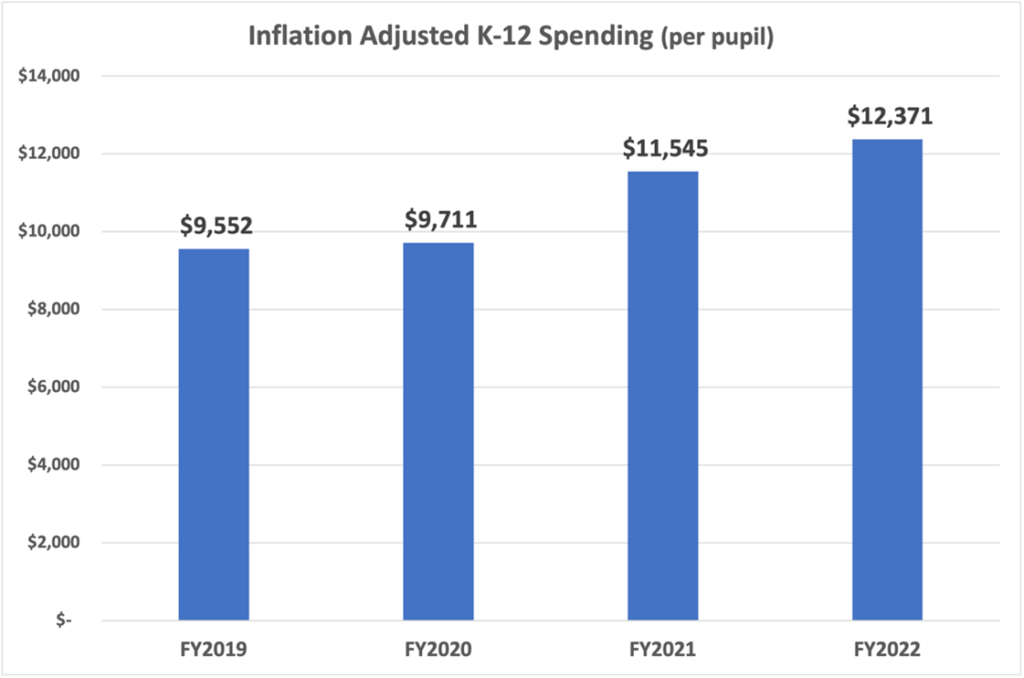
That’s because everything the education establishment and the media has been telling you about K-12 funding levels in Arizona has been one big lie. Education spending in Arizona is at an all-time high, and we know this because we are hitting the K-12 constitutional spending cap.
The K-12 Constitutional Spending Cap Explained
In 1980, Arizona voters approved a series of constitutional tax and spending reforms at the ballot. These reforms were a bipartisan effort to address concerns of reckless spending and skyrocketing property tax increases throughout the state. One of those approved reforms was a limit on the amount K-12 school districts were allowed to spend.
This expenditure limitation is not determined by partisans at the legislature and cannot be manipulated so that politicians can hide how much funding they are providing to K-12. It’s an objective, formula-based spending cap calculated by nonpartisan bean counters on the Economic Estimates Commission consisting of a representative from the Department of Revenue and two other economists.
It’s calculated like this: the Commission takes the funding baseline from the 1979-1980 budget year, adjusts it every year for both student population growth and inflation, and then adds an additional 10% on top. In other words, the spending cap has been allowed to grow annually for 40 years to include both population growth and inflation, plus an additional 10%.
Additionally, this cap doesn’t include multiple funding sources that have been exempted from the cap. For example, the hundreds of millions coming from the Federal Government through the Covid spending packages do not apply toward the expenditure limitation. So when the cap is reached, Arizona taxpayers will know—based on an objective measurement—that K-12 spending is at a historic high.
The Economic Estimates Commission estimates that the education spending cap for FY 2022 will be just over $6 billion. Based on the recently enacted budget, we anticipate that Arizona will exceed the cap, which is why we expect Prop 208 to be ruled unconstitutional and struck down later this year.
Some may be asking: did the backers of Prop 208 know that their measure may trigger the education spending cap, thus tossing their measure into legal jeopardy? Perhaps they were believing their own press clippings about schools being underfunded?
This is the part that should make taxpayers’ blood boil. Not only did the education lobby know that 208 would trigger the expenditure limitation, but snuck language into their ballot measure to sidestep the cap by calling the tax surcharge revenue a “grant.”
That’s right—while they were selling the public on the myth that schools are underfunded and that we need to tax the “rich”, their lawyers concocted a legal strategy to sell judges on the idea that their tax is really a “grant” to avoid hitting a spending cap they knew we were going to hit.
Fortunately for taxpayers and small business owners, the Supreme Court saw through their scam and didn’t come up with some sort of John Roberts-style legal reasoning to save the measure.
One would hope that the education left would have learned a hard lesson from this blunder, but don’t count on it. Instead, their strategy seems to be gaslighting the public into thinking the expenditure limitation is archaic because it was set in 1980. Spreading falsehoods is almost second nature to them. Remember, these are the same people that claimed 208 wasn’t a tax on small business, yet have turned around and sued over SB 1783 because it might prevent small business owners from paying the 208 tax.
Until now the left has believed they can promote false narratives, with the help of the media, about K-12 funding and get away with it. Not anymore – the jig is up, and the lies have been exposed. K-12 funding is at record high levels and because of that, the Arizona Supreme Court decision will likely sink Prop 208 and take this narrative down with it.
Help Protect Freedom in Arizona by Joining Our Grassroots Network
Arizona needs to have a unified voice promoting economic freedom and prosperity, and the Free Enterprise Club is committed to making that happen. But we can’t do it alone. We need YOU!
Join our FREE Grassroots Action List to stay up to date on the latest battles against big government and how YOU can help influence crucial bills at the Arizona State Legislature.
by admin | Aug 26, 2021 | News and Updates, Tax
Last week brought some great news! In an opinion authored by Chief Justice Brutinel, the Arizona Supreme Court ruled that Proposition 208 is unconstitutional and remanded the case back to the trial court.
Now, it’s up to that court to determine whether the constitutional Education Expenditure Limit will be exceeded with Prop 208 monies. And with our state spending a record amount on K-12 education, we are nearly hitting it already—even without Prop 208 dollars.
This billion-dollar tax hike placed on the backs of Arizona’s small businesses will push us over. And that means the trial court must rule that Prop 208 is unconstitutional, killing it once and for all.
This is a big win for the State of Arizona and its taxpayers.
For months on end, Prop 208 voters were deceived. Every major funder, advocate, and organization behind the ill-conceived ballot initiative pushed the same narrative. They said that Prop 208 wouldn’t affect the Arizona economy or small businesses.
But with the passage of this disastrous piece of legislation, our state’s tax rate was raised dramatically to 8%, giving Arizona the ninth highest small business tax rate in the nation.
This wasn’t exactly the kick-off to the new year that small businesses were hoping for. And it even led some businesses—like Landmark Recovery which had been headquartered in Scottsdale—to leave the state.
But Prop 208 is now on its death bed. And once it’s officially struck down, Arizona’s economy will have dodged a bullet.
Of course, the Prop 208 crowd hasn’t given up. They are still actively collecting signatures on referendums to stop the historic tax reforms delivered by Arizona Republicans and signed by Governor Ducey at the end of June. And Invest in Arizona, a political committee sponsored by Arizona Education Association and Stand for Children, even filed a lawsuit against SB1783, which was passed to give tax relief to small business owners in our state.
Apparently, they don’t like the idea of providing $1.8 billion in tax relief to the people of Arizona—or giving every Arizona taxpayer a cut.
But what groups like Invest in Arizona don’t understand is that our state is currently sitting pretty, thanks to a $4 billion surplus. And Arizona taxpayers deserve a break, which is why the Arizona Free Enterprise Club and the Goldwater Institute have asked to intervene in Invest in Arizona’s lawsuit.
And it’s also why The Club filed a lawsuit of our own last month against Invest in Arizona’s tax cut referendums.
The time to cut taxes is now. It is undeniable that small businesses were hit hardest by the COVID shutdowns. And many of them are still trying to dig themselves out of the wreckage.
Invest in Arizona and anyone else who was involved in drafting Prop 208 need to accept the fact that this initiative is unconstitutional. The Arizona Supreme Court recognized that last week. And now the trial courts should do the same.
Help Protect Freedom in Arizona by Joining Our Grassroots Network
Arizona needs to have a unified voice promoting economic freedom and prosperity, and the Free Enterprise Club is committed to making that happen. But we can’t do it alone. We need YOU!
Join our FREE Grassroots Action List to stay up to date on the latest battles against big government and how YOU can help influence crucial bills at the Arizona State Legislature.
by admin | Aug 24, 2021 | News and Updates, Regulatory
It turns out that upending Utility energy production and mandating “clean” energy by an arbitrary date costs money. A lot of money actually—to the tune of over $6 billion according to a new study commissioned by the Corporation Commission.
This study comes over a year after the Commission first announced its Green New Deal Energy Rules. Many votes have taken place since then, votes that would impact ratepayers, yet no independent cost analysis had been done until now.
The green energy lobby repeatedly told the Commission that the mandates (which were rejected by a margin of two to one on the ballot in 2018), would actually save ratepayers money and have an economic benefit of $2 billion. Seemingly everyone in the Corp Comm echo chamber and the media actually believed these suspicious figures. Everyone except Commissioner Justin Olson. He introduced an amendment last April to ensure that costs incurred by Utilities to comply with the mandates aren’t passed onto ratepayers. The amendment failed. It turned out that the same people claiming that energy mandates save people money didn’t believe their own hype and fought to kill this ratepayer protection.
We already know that previous mandates have led to higher utility bills and boondoggle projects. The Renewable Energy Standard and Tariff adopted by the Commission in 2006 (requiring 15% renewable energy by 2025) resulted in APS signing a 30-year contract for solar energy costing 400% above market rates. All passed onto the ratepayer.
Thankfully prior to leaping before they looked, the Commission agreed to conduct a study with an independent firm to identify the potential cost of additional mandates. The firm they hired—Ascend—compares 3 different portfolios of energy production: “Least Cost” which relies on utilities pursuing the lowest cost option for consumers, an 80% clean energy mandate by 2050, and a 100% clean energy mandate by 2050. In order to hit the 80% or 100% mandate requirements, utilities would need to phase out all fossil fuels, purchase more solar and wind generation, expand lithium-ion battery storage and convert natural gas generation to green hydrogen.
The result? The difference between the modelled Least Cost portfolio and the 100% reduction for APS is over $6 billion. That’s $6 billion that would be footed by ratepayers. This comes out to an estimated $60 per month, an 80% increase per bill for the average ratepayer.
There certainly are cost-effective and reliable renewable energy options for utilities. And when it makes sense to invest in or purchase from them, the utilities are free to do so. But those investments should not come at the cost of higher utility bills, and utilities should be required to justify those investments to the Commission.
If a utility makes a bad investment or signs a bad contract, the liability should be on them, not the ratepayer.
But when the Commission adopts mandates, as it did in 2006 and is now considering again, it shifts risk and liability away from utilities (and the dozens of special interest groups that profit from mandates) to ratepayers.
The role of the Commission is to protect ratepayers by ensuring just and reasonable rates, not engage in energy policymaking. By injecting itself into these market decisions, the Commission ties its hands from its constitutional role and allows utilities to dictate rates and harm ratepayers. Instead of new mandates, let the utilities make investments in renewable energy production when and where it makes sense to do so, and in the process protect ratepayers from bad investments and contracts.
Help Protect Freedom in Arizona by Joining Our Grassroots Network
Arizona needs to have a unified voice promoting economic freedom and prosperity, and the Free Enterprise Club is committed to making that happen. But we can’t do it alone. We need YOU!
Join our FREE Grassroots Action List to stay up to date on the latest battles against big government and how YOU can help influence crucial bills at the Arizona State Legislature.
by admin | Aug 20, 2021 | Misc, News and Updates
It needed to be done. At the end of June, Governor Ducey signed HB2898, which included a provision prohibiting a city, town, county, school board, or charter school governing body from requiring students or teachers to wear masks.
Bear in mind that this law doesn’t mean students and teachers can’t wear masks. They certainly can if they want to. But it keeps the heavy hand of government from enforcing unnecessary restrictions—especially on students who should be focused on learning.
Predictably, the liberal left has had a meltdown. The board president at Northland Preparatory Academy in Flagstaff went on a tirade in a now-removed Facebook post, referring to parents and students who disagree with mask mandates as “the worst of humanity.”
And some schools have decided that their first lesson for the year is to teach kids it’s ok to violate the law. A growing number of Arizona school districts are openly defying Governor Ducey by requiring students and staff to wear masks if they want to set foot on campus.
Our children have become pawns in a game of COVID chess—all at the mercy of the kings and queens on school boards throughout the state.
While parents are speaking up, they need help. Thankfully, Arizona’s House and Senate Republicans heard their cries. Last week, a group led by state representative Jake Hoffman called for Governor Ducey to do something.
And earlier this week, he delivered. Governor Ducey announced an initial $10 million investment for Arizona’s COVID-19 Recovery Benefit Program. This means that families facing financial and education barriers due to unnecessary school closures and mandates that are not in compliance with state law now have a choice.
Starting on August 20, families that have a total household income up to 350 percent of the Federal Poverty Level can apply for up to $7,000 per student for needs related to childcare, transportation, online tutoring, and tuition. Parents and families that apply simply need to show that their current school is isolating, quarantining, or subjecting children to physical COVID-19 restraints—like requiring the use of masks or giving preferential treatment to those who have been vaccinated.
This is an important decision by Governor Ducey. And it’s the right one. While COVID was certainly an issue that warranted some action, it never should have included trampling on the rights of the people.
And our kids should never be forced to wear masks. No study has been completed to back them up, and there’s a very good chance that widespread masking could cause children psychological harm.
School districts need to follow the law. And if they don’t, they should be held accountable. It’s time to put the power back into the hands of parents. They should be given a choice to find alternative learning solutions for their children because students deserve access to the best education possible.
Thankfully, Governor Ducey took a step in the right direction this week by putting the needs and development of our kids first.
Help Protect Freedom in Arizona by Joining Our Grassroots Network
Arizona needs to have a unified voice promoting economic freedom and prosperity, and the Free Enterprise Club is committed to making that happen. But we can’t do it alone. We need YOU!
Join our FREE Grassroots Action List to stay up to date on the latest battles against big government and how YOU can help influence crucial bills at the Arizona State Legislature.
by admin | Aug 17, 2021 | Elections, News and Updates
Today Arizonans for Voter ID, a committee sponsored by the Arizona Free Enterprise Club, filed with the Secretary of State the Arizonans for Voter ID Act ballot initiative. The purpose of the measure is to bring integrity and security to our election process by requiring that no matter how you vote or where you vote, you will be required to provide valid ID when casting your ballot.
Voters in Arizona overwhelmingly agree that they want an election process that they can believe in and trust. One where it is easy to vote yet hard to cheat.
The Arizonans for Voter ID Act Initiative consists of four key provisions:
- Improving existing in-person Voter ID requirements
- Requiring Voter ID on mail-in ballots
- Preventing Ballot Harvesting by enhancing voter ID requirements for in-person ballot drop off
- Providing a free voter ID option to lawfully registered Arizona voters who need it for voting
Easy to vote, and hard to cheat – that’s the benchmark for elections. US Supreme Court Justice Samuel Alito in the recent Brnovich v. DNC decision upholding two Arizona election integrity laws stated that, “[Arizona law] makes it quite easy for residents to vote.” Arizonans have the option to vote in-person on election day, early in-person beginning 27 days before an election, and by mail with a one-time request or perpetually through the Active Early Voter List – no excuse required.
This initiative maintains Arizona voters’ accessibility to the ballot box while improving our election processes, especially with requiring objective identification on mail-in ballots. This will prevent legal votes from being rejected and illegal votes from being accepted.
Poll after poll shows that Arizonans overwhelmingly support Voter ID. A poll from April showed that 82% of likely Arizona voters agree that all voters should be required to provide identification before voting. This includes majority support from every race, ethnicity, Republicans, Democrats, and Independents.
And the popularity should be no surprise. Arizonans use these forms of identification commonly in their everyday lives to purchase alcohol or cigarettes, obtain a driver’s license, board a commercial flight, donate blood, open a bank account, purchase a firearm, receive unemployment benefits, obtain auto insurance, purchase or rent a home, confirm identity over the phone, and many other basic transactions.
The Initiative is already supported by a growing coalition of both state and national organizations including Heritage Action, Honest Elections Project Action, Foundation for Government Accountability, Goldwater Institute, Arizona Women of Action, AMAC Action, the Republican Liberty Caucus of Arizona, and EZAZ.org.
“The vast majority of Arizona voters support voter ID because it is a common-sense and critical election integrity practice that is increasingly implemented around the country,” said Scot Mussi, President of the Free Enterprise Club. “This initiative will ensure that no matter when you vote, where you vote, or how you vote, identification will be required.”
The Arizonans for Voter ID Committee is chaired by Arizona voter Vicki Vaughn and Bill Luhrs serving as Chair and Treasurer. To qualify for the 2022 November ballot, the campaign will need to gather 237,645 valid signatures by July 7th.
Now Is the Time for Universal Voter ID in Arizona.
Voter ID requirements are commonsense, help ensure the integrity of our elections, and protect the ballot of every qualified Arizona voter.
Learn more about the Arizonans for Voter ID Act Initiative.
Recent Comments