Leading under divided government is hard, but it does not excuse a governor from actually governing. Republican legislative leadership has held a clear and defensible line when it comes to the state’s budget: spend only the revenues the state actually has, provide full tax relief by implementing full conformity and don’t force Arizonans to file their taxes twice and pay more in the process. When Hobbs couldn’t move them off that position last week, she didn’t really explain why their position was unreasonable or come back with a new proposal. Instead, she walked away from the table.
Recently, a rumor was circulating around the Capitol that the Governor and legislative leadership were discussing a deal to deliver conformity tax cuts and build the contours of the budget around a speculative state land trust ballot referral. Referring a Prop 123 extension would dump hundreds of millions of new dollars into district K-12 schools without any strings attached. By the end of last week, that balloon had popped, along with any credibility that Katie Hobbs knows how to lead.
As governor, it is Katie Hobbs’ job to bring people together and solve difficult problems. Yet before the calendar has even turned to April (very early for budget season at the capitol), Governor Hobbs has already admitted that she is out of ideas.
The Prop 123 Gimmick Was Never Going to Work
Now that the budget breakdown has gone public, details of the Hobbs proposal have been released, and it was far worse than anyone had even thought. Under the Hobbs plan, Arizona’s entire budget would somehow hinge on the passage of a new Proposition 123 referral at the ballot in November.
Currently, the annual distribution from the trust to the beneficiaries is 2.5% of the corpus. What did Hobbs want? 10.9% over 20 years!
According to legislative budget analysts, ratcheting up outlays to 10.9% would cut the trust nearly in half – from $9.7 billion to $4.7 billion – over two decades. This is not a budget solution; it is a structural raid on an endowment built to support K-12 education for generations.
When then Governor Ducey pushed for an increase in trust land distributions in 2015 from 2.5% to 6.9%, he did so with the explicit understanding that it was temporary. Even that modest increase was seen at the time as aggressive, with voters approving it by a razor thin margin of 50.9 percent. And when the larger distribution was set to expire last year, the legislature appropriated additional ongoing funds from the general fund to avoid any “funding cliff” for K-12.
Katie Hobbs, however, sees this as a way to add hundreds of millions to the state budget to pay for additional spending. Only one problem: she can’t actually attach Prop 123 to the budget. Perhaps no one explained this to Hobbs, but funds from the trust cannot be appropriated by the legislature or Governor. It’s a separate pot of money owned by the beneficiaries of the trust. So even if she does have a crystal ball and knows that voters would approve her reckless distribution plan, it has no bearing on what a final FY2027 budget would even look like.
In short, this is a reckless, unworkable gimmick being pushed by a desperate politician looking for leverage in budget negotiations.
Full Conformity Has Occurred. Hobbs Just Refuses to Admit It.
The $440 million in conformity tax relief for Arizona filers this year alone is not the negotiating chip Hobbs wishes it were. It is a foregone conclusion. Her own Department of Revenue has already published tax forms assuming full conformity with the federal tax code.
Arizonans are filing their taxes with those forms right now, because the alternative – rolling back full conformity and forcing millions of taxpayers to file their taxes twice and pay more when they do it – is not a position any elected official can defend. Hobbs is trying though, refusing to publicly state whether she has abandoned her conformity plan from January that would lead to tax season chaos.
She has already vetoed two conformity bills. She blocked a special session that would have resolved the question cleanly. She built this mess. Whatever leverage she imagines she has with conformity is a bluff, and Republicans should call it. There is nothing to trade here.
That leaves Hobbs with the problem she has been dodging since day one: how to pay for it. She has no answer, and she doesn’t want one. Instead, she has invited Republicans to simply send her a budget that she will “evaluate,” which is code for waiting around doing nothing and then saying no. That is her playbook. Hobbs manufactures the crisis, Republicans put solution after solution on her desk, and she vetoes them all without offering anything workable in return.
Republicans Just Have to Hold the Line
Republicans don’t need to trade away permanent tax relief for a budget gimmick that will never materialize, tied to a trust fund that doesn’t belong to state appropriators to begin with, to solve a problem Hobbs created and her own agency has already been forced to work around.
The path forward is already on the table: full conformity paired with responsible offsets that require neither a ballot box nor a land trust raid. And since Hobbs has now thrown up her hands and demanded that Republicans produce a budget for her to “evaluate,” (with no ideas of her own) they can and should take their time and do it right.
Chaos Katie can storm off all she wants. The legislature should keep the lights on and keep working for an Affordable Arizona.
Help Protect Freedom in Arizona by Joining Our Grassroots Network
Arizona needs to have a unified voice promoting economic freedom and prosperity, and the Free Enterprise Club is committed to making that happen. But we can’t do it alone. We need YOU!
Join our FREE Grassroots Action List to stay up to date on the latest battles against big government and how YOU can help influence crucial bills at the Arizona State Legislature.
Arizona’s legacy media is at it once again—going after our state’s highly popular Empowerment Scholarship Account (ESA) program, which now sits at over 100,000 enrollments.
Last month, activist reporter Craig Harris, from 12 News, pushed his latest “investigation” claiming that the ESA program had fraud totaling 20 percent. Certainly, if such a level of fraud is accurate, it deserves a full investigation. But it didn’t take long before the truth—and the real data—revealed itself.
According to the Arizona Department of Education (ADE), Harris’s 20 percent fraud claim originated from a risk-based audit, which was not only limited in scope, but also targeted higher-risk participants and accounts. But it did not account for the entire ESA program. Instead, the ADE referred to a study by a Stanford PhD that showed a more accurate assessment of fraud at 0.3 percent. That’s quite a gap between the 12 News report and reality. Perhaps Harris is getting math lessons from his buddies in the teachers’ unions who, as we know, have never exactly been good at counting.
As Harris continued to push his vendetta against school choice on social media this past weekend, he was completely ratioed for his debunked ESA fraud claims. And the best part? He was also unmasked as a partisan liberal with Red for Ed conflicts of interest and a history of publishing defamatory stories that are still being litigated.
That’s right. It turns out that Harris’s wife is an activist aligned with the Red for Ed teachers’ union, who promotes their propaganda on her Facebook page. Is it possible that such a conflict of interest could have had an impact on Craig Harris’s—dare we say—fraudulent reporting?
Of course, this isn’t the first time Harris has published defamatory stories with questionable evidence. In 2018, the activist reporter was caught making up a quote from then-Governor Doug Ducey in an attack on charter schools. And his malicious reporting is also at the center of a lawsuit in Texas against Gannett Publishing Services (which owns the Arizona Republic). Then, there was last year when he wrote a misleading story that left out important facts, claiming that Primavera, an online charter school, failed to meet the minimum academic requirements for a traditional charter school.
It’s amazing that 12 News continues to employ someone with such low journalistic standards, but that’s the legacy media for you. They are fully committed to their leftist agenda, especially when it comes to the teachers’ unions. But thankfully, we have alternate media today, in particular Twitter/X and AZ Free News, which makes it possible to rebuke such activist reporters.
Ten years ago, if a reporter like Craig Harris wanted to do a hit job on a conservative politician or a program that the left hates (like ESAs and school choice), he would have pumped out story after story, and the targets of the hit would have been largely helpless in fighting back. That’s because the legacy media, especially at the local level, controlled the flow of information. And there was not much we could do about it.
But that’s no longer the case.
Twitter provides the channel for immediate and real-time pushbacks on these hit pieces. And alternative news outlets, like AZ Free News, provide journalism with real facts and the truth to debunk their claims. In fact, AZ Free News was probably the number one source used to push back against Harris. (See here, here, here, and here—for a small sampling.)
The result of all this is a level playing field, and it drives the legacy media nuts. Craig Harris was so unnerved by the pushback he received on social media that he started blocking all his critics. And then, he tried to defend his blocking by claiming that people were posting pictures of his family. But it turns out that his attempt to play a doxxing victim was just another false claim. There were no images of his family posted, only public images from social media pages that showed his family is a huge supporter of the Red for Ed teachers’ union. Although one image did include a picture of his dog—perhaps that is the family member he is claiming was “doxxed.”
The truth is that Craig Harris wasn’t upset about any alleged doxxing. He was upset that he was caught for his shoddy reporting and not disclosing his conflict of interest. And let’s not forget the irony: Harris sent his own children to private schools while disparaging programs that allow other families to do the same. His reporting isn’t just misleading. It’s a textbook example of agenda-driven journalism.
The lesson here is clear. Legacy media can no longer operate unchecked. Thanks to alternative outlets like AZ Free News, activists, parents, and taxpayers now have the power to challenge false narratives and hold reporters accountable. The ESA program deserves such defenders. Craig Harris may have tried to shape the narrative, but the truth has a louder megaphone. And Arizona families aren’t buying his false headlines.
Help Protect Freedom in Arizona by Joining Our Grassroots Network
Arizona needs to have a unified voice promoting economic freedom and prosperity, and the Free Enterprise Club is committed to making that happen. But we can’t do it alone. We need YOU!
Join our FREE Grassroots Action List to stay up to date on the latest battles against big government and how YOU can help influence crucial bills at the Arizona State Legislature.
Katie Hobbs would love nothing more than for Republicans at the legislature to start wheeling and dealing on Prop 123, the roughly $300M per year K-12 funding stream from Arizona’s State Land Trust.
Republicans should not even entertain it.
In fact, negotiating over Prop 123 now would amount to a political self-own of the highest order.
Prior to 2025, the argument for extending Prop 123 was the imminent “funding cliff” for school districts because the distributions from the land trust to K-12, which were temporarily increased for a period of 10 years, were set to expire. But lawmakers addressed this concern when they increased K-12 funding from the general fund a few years ago in the amount districts were receiving from the trust.
Last year, there were discussions about initiating a new 123 enhanced distribution, but only if it included significant education reforms, one of which involved constitutionally protecting school choice programs in the state. Outside of these types of reforms, there is no reason for Republicans to even be discussing any plan that involves dumping hundreds of millions into K-12 with no strings attached.
Yet somehow the conversation has been resurrected.
There continues to be talks around referring a “clean” Prop 123 extension as part of a budget deal with Katie Hobbs. The governor even appears to want this in return for “giving” Republican lawmakers a $1.1B tax cut in the budget associated with conformity to federal tax cuts in the One Big Beautiful Bill (OBBB).
But the reality is this isn’t real leverage for Chaos Katie at all. The $440M required to deliver the OBBB tax cuts to Arizonans for this year is a foregone conclusion. Hobbs signed herself up for this conformity plan when her own Department of Revenue issued forms at the beginning of the year that assumedfull conformity (and all of the tax relief that goes along with it). Any attempt to undo this would make her personally responsible for a million Arizonans having to refile their tax returns and PAY MORE when they do it.
Hobbs dug herself a hole. Now she is attempting to use Prop 123 as a mechanism to climb out of that hole because she is desperate for some type of win.
So why would any Republican even consider such an idea?
Unfortunately, rumors circulating around the Capitol suggest that some Republicans may be tempted to play along because they really want to spend more money and extending Prop 123 would hopefully free up capacity in the budget.
The problem with this idea from a budgeting standpoint is that it is completely nonsensical and reckless. A new Prop 123 plan would require voter approval in November, so any budget passed would supposedly hinge on something that might fail in six months. Additionally, this entire concept ignores the fact that the money distributed from the trust does not belong to the state; it is owned by the beneficiaries of the trust. Neither the legislature nor the Governor is allowed to appropriate these funds. So how would this be properly accounted for in any budget? The answer to this question is that it cannot.
Which is why the only winner in a political drug deal like this would be Hobbs.
Republicans must abandon negotiating on these terms. Accepting a Prop 123 deal is bad policy and bad politics. It is not even a “compromise” – it’s a political bailout for Hobbs.
Sometimes the smartest move in politics is the simplest one.
Craft a budget around the actual budget, which only includes the revenues collected and spent by the state’s general fund. Stop tying in unrelated items being sought by desperate politicians in an election season.
Let the governor explain why she vetoed conformity legislation while her own Department of Revenue assumed full conformity. Or why she wants people to file amended returns and pay more in taxes when they refile.
Because if Republicans decide to unilaterally surrender on 123, they will not be solving any “budget problems” but rather underwriting the Hobbs’ reelection campaign.
And that is a deal Katie Hobbs would happily take every time.
Help Protect Freedom in Arizona by Joining Our Grassroots Network
Arizona needs to have a unified voice promoting economic freedom and prosperity, and the Free Enterprise Club is committed to making that happen. But we can’t do it alone. We need YOU!
Join our FREE Grassroots Action List to stay up to date on the latest battles against big government and how YOU can help influence crucial bills at the Arizona State Legislature.
While some legislators are working to keep California-style policies out of Arizona, corrupt municipal leaders in cities such as Phoenix and Tucson clearly haven’t gotten the memo. For years, these cities have subjected businesses to an unfair fee for their own shopping carts being stolen. Rather than targeting theft, homelessness, or law enforcement strategies, this policy shifts blame onto retailers, effectively punishing the victims. A classic California-esque idea infecting our Arizona cities.
Representative Nick Kupper introduced HB2460 this legislative session to combat this insanity and introduce some common sense. This bill prevents local governments from fining retailers over abandoned movable property, such as shopping carts and handheld baskets. Retailers already lose money from cart theft; charging them to reclaim their own stolen property is ridiculous.
This type of policy is the definition of “California-ing Arizona.” California has regulated abandoned shopping carts for decades, with state law dating back to 1992 authorizing cities to penalize retailers when carts are not retrieved from public spaces. Tucson and Phoenix are now following in those footsteps. Arizona law ARS 44-1799.33 already establishes procedures for dealing with abandoned shopping carts, including notice to the owner, impoundment, cost recovery, and eventual disposal if the cart is not retrieved, without automatically penalizing retailers.
Arizona should be a state that prioritizes accountability and property rights, but these cities seem intent on breaking that mold.
Tucson started back in 2013 when the city council approved an ordinance requiring retailers to retrieve abandoned shopping carts that end up off of their property. If they fail to pick up a cart within three days after notification, the city impounds it and charges the retailer a $30 retrieval fee. After 30 days, the fee is automatically added to the company’s water bill, and the cart is either sold or discarded. Retailers bear the burden after their property has already been stolen.
Phoenix has an even longer history of penalizing retailers through its Abandoned Shopping Cart Retrieval Program, first authorized as a pilot in 2005 and officially established in 2007. The program charges retailers a fee when city crews collect carts found off-site. Over the years, the fees have increased from $20 in 2007 to $50 by 2017, supposedly to “incentivize better management” of their property. Just this year, the city expanded its approach with a new ordinance requiring annual retailer certification, management plans, and higher penalties for non-compliance.
While Phoenix and Tucson have some of the longest histories with this bad policy, other Arizona cities including Avondale (2020), Glendale (2023), Maricopa (2022), and Peoria (2008) have adopted similar shopping cart ordinances. Whether through retrieval fees, regulatory requirements, or mandated anti-theft measures, the trend reflects a growing statewide shift toward placing increased responsibility on retailers for cart loss and abandonment.
Cities defend these policies by arguing that abandoned shopping carts impose public costs: blocked sidewalks, poor aesthetics, and cleanup time. Framing the policy as cost recovery rather than punishment, they claim retailers are best positioned to prevent loss through management systems or retrieval services.
During the committee hearing on HB2460, a representative of the City of Phoenix even argued that enforcing the law against thieves would be problematic because retailers would be prosecuting their customers. Last I checked, people who steal carts are not law-abiding citizens merely buying groceries, they’re criminals. In that same discussion, a Democrat lawmaker claimed that preventing cities from imposing these fines would be government overreach. It truly feels like we are living in an upside-down world.
But there is no good rationale for these ordinances. If theft is the problem, why not prioritize enforcement and deterrence? Shifting the burden onto retailers normalizes the crime and encourages continued bad behavior. Why would it ever stop if the guilty never face repercussions?
These unjust ordinances are the gateway to further punishment of the innocent while the guilty walk free. It starts with shopping carts, then Arizona will go full-blown California and allow squatters to take over homes and punish the rightful property owners.
HB2460 is necessary to protect retailers from being fined for retrieving their own stolen property. This shouldn’t even be a debate. In America, your property is yours, and those who steal it should face consequences, not the victims of the theft. That is justice. The bill passed the Arizona House in late February on a party-line vote and now heads to the Senate. We encourage the Senate and the governor to move quickly to pass and sign the measure to reaffirm basic property rights and ensure businesses are not punished for crimes committed by others and reject the creeping wave of California-style policies before they take deeper root in our state.
Help Protect Freedom in Arizona by Joining Our Grassroots Network
Arizona needs to have a unified voice promoting economic freedom and prosperity, and the Free Enterprise Club is committed to making that happen. But we can’t do it alone. We need YOU!
Join our FREE Grassroots Action List to stay up to date on the latest battles against big government and how YOU can help influence crucial bills at the Arizona State Legislature.
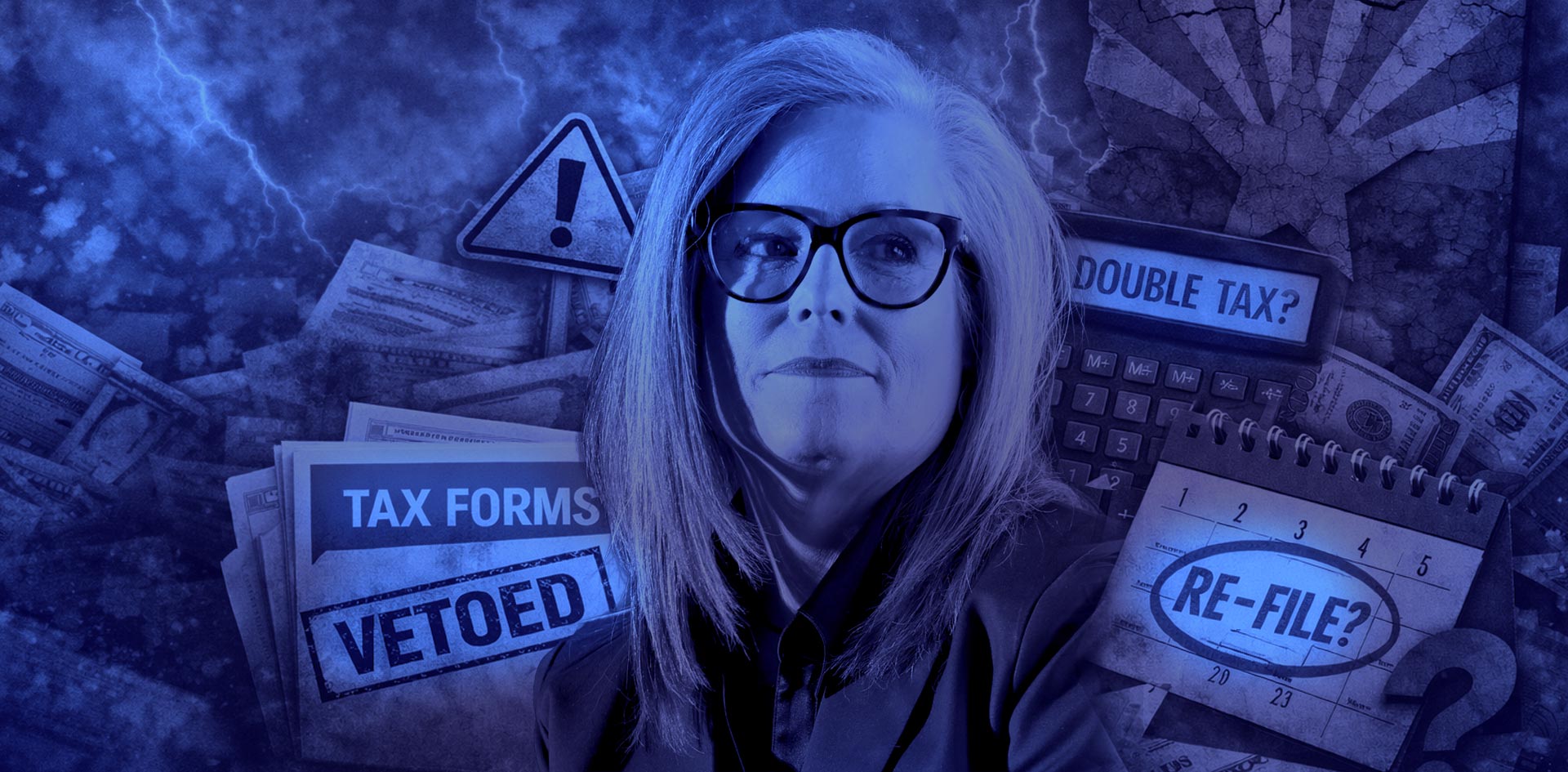
Arizona’s executive branch has been defined by dysfunction, delay, and confusion. And Katie Hobbs has led that chaos from the front. When it came to tax conformity, Arizona had a clear choice: conform to the federal tax code and provide relief to working-class Arizonans or refuse conformity and raise taxes at the exact moment families could least afford it.
Instead of choosing relief, or even choosing clarity, Katie Hobbs created a third option:
Complete and utter chaos.
The Hobbs Chaos Conformity Plan
Sensing the urgency of the situation, Republican lawmakers called on Hobbs to convene a special legislative session in December, well before tax season, to address tax conformity and provide certainty for Arizona taxpayers.
Hobbs refused.
Then, during her State of the State address, Hobbs demanded that lawmakers adopt her own conformity plan, a package that would result in a $200 million tax hike on Arizonans.
There was just one problem: not a single lawmaker—Democrat or Republican–had introduced her plan as an actual bill.
The Hobbs “plan” didn’t even exist.
Then the dysfunction within her administration spiraled out of control. The Arizona Department of Revenue, a state agency operated by Governor Hobbs, issued tax forms in January that didn’t match the conformity plan proposed by Governor Hobbs. In fact, the DOR forms are more closely aligned with what Republicans wanted that what Hobbs had asked for.
Hobbs can’t even get on the same page with her own office.
So, in an attempt to end the chaos and confusion being created by Hobbs, the GOP-led legislature passed HB 2785, a tax conformity package that aligned Arizona law with the tax forms issued by Hobbs’ Department of revenue.
What did Hobbs do? She Vetoed it.
A Completely Avoidable Tax Disaster
The result of this failed and chaotic leadership?
More than 1 million Arizonans may now be forced to refile their taxes and potentially pay hundreds of millions of dollars more.
1. Republicans offered solutions.
2. Republicans passed legislation.
3. Republicans tried to provide certainty.
Katie Hobbs blocked every single attempt.
Arizona Deserves Competent Leadership
Arizonans expect their Governor to solve problems, not create them. But Katie Hobbs has shown a pattern of doing exactly the opposite. This tax season fiasco isn’t just another policy disagreement. It’s proof of something far more serious: Katie Hobbs is simply not capable of governing effectively.
Arizona Taxpayers Should Be Furious
Arizonans should be absolutely outraged.
No family should ever be forced to file their taxes twice because their Governor failed to do her job. No small business should face new tax confusion because the Governor vetoed common-sense solutions. And no taxpayer should be asked to pay more simply because the Governor chose political games over responsible leadership.
Yet that is exactly what Katie Hobbs has done. Her incompetence has created a completely unnecessary tax crisis for Arizona families. That’s why Arizonans are speaking out and demanding accountability.
Learn the truth about Governor Hobbs’ failed leadership at:
Call Governor Hobbs
Arizona taxpayers deserve certainty, not chaos.
Call Governor Katie Hobbs’ office at (602) 542-4331
Tell her: Arizona taxpayers should not have to file their taxes twice because of her incompetence.
Help Protect Freedom in Arizona by Joining Our Grassroots Network
Arizona needs to have a unified voice promoting economic freedom and prosperity, and the Free Enterprise Club is committed to making that happen. But we can’t do it alone. We need YOU!
Join our FREE Grassroots Action List to stay up to date on the latest battles against big government and how YOU can help influence crucial bills at the Arizona State Legislature.

Recent Comments