
FLOCK Cameras are Invading – Coming Soon to a City Near You
Don’t you want to live in a crime-free utopia? Wouldn’t allowing the government to track our every move, solve all our problems? Local authorities seem to think so, and they have the perfect tool to usher in mass surveillance in your city: Flock cameras. Flock Safety is one of the main manufacturers of Automatic License Plate Readers (ALPRs) that have been quietly taking over cities and have already infiltrated nearly every state. These cameras monitor cars and even pedestrians constantly, logging minute details about every vehicle that passes, storing the data in Flock’s database, and feeding it into an AI platform with the capability of stitching together elaborate travel patterns. No court-issued warrant is required – not even public consent – creating massive privacy concerns for residents who often don’t know they are being watched until these cameras have saturated their community.
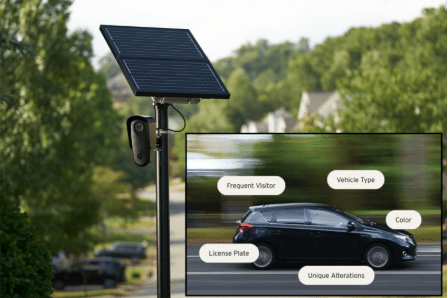
According to Flock’s own website, they cover 49 states, over 5,000 communities, partner with more than 4,800 law enforcement agencies, and read upwards of 20 billion license plates per month. Though law enforcement agencies are one of the primary users of these devices stated to reduce crime, cities, businesses, and even HOAs are also deploying them in residential areas.
You might think, “We don’t have these in our town.” But sometimes these cameras show up without public approval. That was the case in Sedona where the police department partnered with Flock and quietly set up 11 cameras around the city without notifying the city council. Once the council found out, they held a public meeting, heard residents’ concerns, and ultimately terminated the contract and removed every camera.
City of Flagstaff too has seen controversy over whether to renew their Flock contract for 36 ALPRs. Their council recently delayed a vote until they could get more public feedback and revisit their contract terms with Flock. The Town of Prescott Valley, AZ has 101 cameras. Tolleson, AZ has 77. Scottsdale, AZ uses dozens of Flock cameras and recently voted to remove specific references to license plate readers, photo radar, and AI technologies from its 2026 Legislative Agenda. The fight is ongoing across the state.
Casa Grande, Arizona in Pinal County, recently approved a 10-year contract with Flock totaling $10 million for 100 ALPRs, 100 pan-tilt-zoom cameras, 10 video cameras, a gunshot detection system, and additional surveillance devices. With 22 ALPRs already operating and 100 more on the way, no one will be cruising around Casa Grande without the government’s careful observation. Yet the Casa Grande police chief brushes off privacy concerns, saying: “I know people are worried about Big Brother… But if they’re calling or emailing with these concerns on their phone, that phone is capturing a thousand times more information than Flock will.” In other words, you’re already being tracked, so what’s a little more?
While Arizona is home to some of the most Flock-saturated cities in the country, the problem stretches far beyond our borders.
In Norfolk, Virginia, for example, 176 Flock cameras blanket the city. In a recent lawsuit, two Norfolk residents discovered their locations had been logged hundreds of times in less than five months: one was tracked 526 times, the other 849. These are ordinary citizens whose movements were recorded and stored for 30 days.
Oakland, CA owns 293 cameras. Denver, CO has over 100. McDonough, GA has 60. And the list keeps growing. If you want to know whether your city already uses Flock cameras, the website deflock.me shows a map of nearly 55,000 ALPRs worldwide and is growing every day, though this only lists a fraction of what is out there (Flock has over 84,000 ALPRs in the United States alone). Turns out it is harder to track the tracker, and there is no legal requirement that these governments provide a transparent database of when and where you are being surveilled.
If your city doesn’t have them yet, the city next door does. Because Flock freely shares data across jurisdictions, your information can cross state lines and land in the hands of any law enforcement agency or private company connected to the network. Many jurisdictions (including the Town of Prescott Valley) have actively sought private residences and businesses to connect their camera systems into their Flock surveillance systems – which given enough participation by private surveillance systems and Flock’s emerging use of drones would leave few places outside of government’s voyeurism. Flock boasts this integrated network as “coverage that never sleeps,” an eerie and disquieting promise.
Which is probably why people and groups that span the political spectrum oppose these ALPRs en masse. American Civil Liberties Union (ACLU) oppose the surveillance of “immigrants, transgender people, Black and Brown people” while Institute for Justice points out having a government log every trip to church and the gun store is likely to make conservatives squeamish. IJ has been involved in multiple lawsuits (including the above-mentioned in Norfolk) to protect against the threat these cameras pose to “people’s privacy, security, and freedom of movement.”
Maybe you’re like the Casa Grande police chief who insists these license plate readers are no different from tech companies tracking your cellphone. But the difference is, Flock monitors your movement constantly, often without your knowledge, and always without your consent. You can turn off your phone. You can’t turn off a camera mounted on a pole. Every car you drive and every route you take is automatically logged, creating a permanent record you never agreed to.
If Flock isn’t in your city yet, they’re probably on their way. Remind your council members that these cameras don’t belong anywhere near your neighborhood and that you didn’t sign up for 24/7 government monitoring.
Help Protect Freedom in Arizona by Joining Our Grassroots Network
Arizona needs to have a unified voice promoting economic freedom and prosperity, and the Free Enterprise Club is committed to making that happen. But we can’t do it alone. We need YOU!
Join our FREE Grassroots Action List to stay up to date on the latest battles against big government and how YOU can help influence crucial bills at the Arizona State Legislature.
Recent Comments