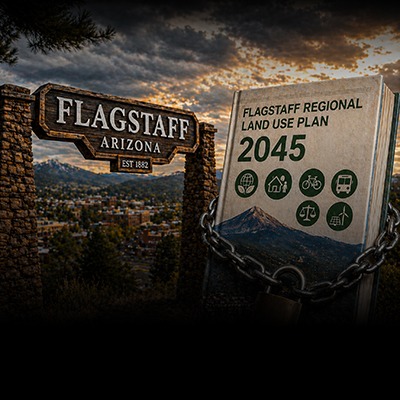
Flagstaff residents have until May 19th to vote on the Flagstaff Regional Land Use Plan 2045, a mail-in only election that will determine whether this becomes the city’s guiding blueprint through 2045. The plan will shape “growth, development, conservation, housing, transportation, and other long-term community priorities.” It is a roadmap for how city leaders want Flagstaff to grow, move, build, and live for the next two decades.
The main themes of this Regional Plan are Climate Action, Housing Attainability and Equity. Climate and equity, two of the left’s favorite virtue-signaling obsessions. The plan runs roughly 250 pages and buried inside the planning jargon is a much bigger agenda: a comprehensive restructuring of everyday life in Flagstaff.
The plan repeatedly sounds the alarm over the so-called “climate emergency,” declaring that “climate change, driven by human-induced GHG emissions, is intensifying global weather disruptions.” Translation: the climate is spiraling into chaos, and it’s your fault, therefore the city government now needs to center major policy decisions around climate activism.
The plan repeatedly references Flagstaff’s Carbon Neutrality Plan (CNP) that has the goal to “achieve carbon neutrality by 2030.” What is supposed to be a land use and regional planning document instead reads like an environmental manifesto. In city government’s attempt to “save the planet,” residents should expect pressure for more mandates, regulations, and costly transitions as officials target emissions from “buildings, transportation, waste, etc.” Their call for the “displacement of fossil fuel-based generation with zero-carbon sources such as wind, solar, and nuclear energy,” will inevitably drive-up costs – even in the areas, like housing affordability, they claim to be trying to reduce.
Transportation is another major target. The plan states that “Reducing VMT (vehicle miles traveled) is critical to reducing emissions.” To accomplish that, it promotes street redesigns such as “narrower vehicle lanes” to “encourage slower driving speeds” and give more space to bikers. In plain English, road space would be taken away from drivers and handed over to planners’ preferred modes of transit. These changes would increase congestion, inconvenience commuters, and reduce accessibility for the people who rely on cars every day.
The plan also seeks to turn Flagstaff into a collective of 10- or 15-minute cities, promising to create a “walkable public realm” and build a place where “people can access jobs… without relying on cars.” That may sound utopian to planners, but most residents are not eager to ditch their cars and reorganize their lives around government-designed transit corridors and bike paths.
Even after the road diets, redesigns, restrictions, and behavior-changing policies, Flagstaff admits their “plan” won’t work. After implementation, with all the scenarios tested, they would fail to reduce total Vehicle Miles Traveled below 2024 levels. Unsurprising, a presumptive admission of failure does not dissuade the city from trying to force all their bad ideas on voters anyway.
Lastly, comes the favorite buzzword of modern bureaucrats: equity. The plan says officials should “prioritize residents most affected” and ensure costs and benefits are distributed “equitably.” That sounds harmless until you realize “equity” is often used as a catch-all excuse for government to pick winners and losers. It becomes justification for deciding who gets resources first, which neighborhoods are favored, and whose priorities move to the front of the line. Who decides what is equitable? What tradeoffs are made behind closed doors? When government replaces equal treatment with vague social-engineering language, taxpayers should beware.
Good planning should expand opportunity, protect affordability, and preserve personal autonomy, not micromanage how people travel, live, and consume energy – which seems to be the entire purpose of Flagstaff’s proposed 2045 Regional Plan.
So, Flagstaff voters, is this a practical plan for Flagstaff’s future, or an ideological wish list dressed up as urban planning? On May 19th, residents will decide.
Help Protect Freedom in Arizona by Joining Our Grassroots Network
Arizona needs to have a unified voice promoting economic freedom and prosperity, and the Free Enterprise Club is committed to making that happen. But we can’t do it alone. We need YOU!
Join our FREE Grassroots Action List to stay up to date on the latest battles against big government and how YOU can help influence crucial bills at the Arizona State Legislature.