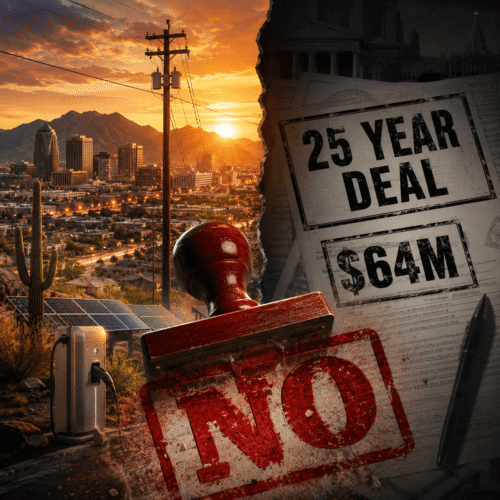
This November, Tucson voters are being asked (again) to approve a 25-year franchise agreement between Tucson and Tucson Electric Power (TEP). Franchise agreements are generally standard arrangements that allow utilities to use public rights-of-way for poles, wires, and infrastructure. But there is nothing standard about this deal. Bundled with it is an “Energy Collaboration Agreement” that will quietly embed climate policy into Tucson’s governance for the next quarter century. Voters should read the fine print (and the price tag) before checking the box.
If Tucson voters are having déjà vu reading this proposal, it’s because it is awfully similar to what they have already said no to. In May 2023, Proposition 412 put a nearly identical TEP franchise agreement before the public, and voters rejected it by a 55-45 margin. That deal included a new 0.75% “community resilience fee” on top of the existing 2.25% franchise fee, with proceeds earmarked for undergrounding utility lines as well as funding the city’s Climate Action Plan. Despite voters already telling the city they don’t want it, city leaders and TEP have assumed residents really just want a more expensive version of the same thing – rebranding and trying to ream through for a second time the same agenda but at a cost of $64 million instead of $56 million.
What the franchise agreement really does is help TEP maintain infrastructure, expedite permitting, and improve outage response. But TEP can still operate without a franchise agreement, meaning this vote is not about whether Tucson continues receiving electricity. Instead, it creates the legal foundation for a broader political partnership between the city and the utility.
The $64 million Energy Collaboration Agreement tied to the franchise deal would funnel TEP money to the city starting at roughly $2 million annually and escalating over time, bankrolling climate-related projects under Tucson’s Climate Action and Adaptation Plan, branded as “Tucson Resilient Together” (TRT). The wish list includes expensive decarbonization mandates, a push for “100% clean, renewable citywide energy supply by 2045,” EV charging infrastructure, transportation electrification, rooftop solar, battery storage, home energy retrofits, and a grab bag of other Green New Scam initiatives that would make Alexandria Ocasio-Cortez proud.
Tucson leaders have acknowledged this funding would pay for programs that otherwise may not be funded because of budget constraints. Rather than debating these spending priorities publicly year after year, the city would effectively lock them in through what is presented as a routine utility deal.
TEP claims the funding will come from “corporate resources” rather than customer rates. This is a distinction without a difference. TEP is a regulated monopoly. Every dollar it spends ultimately flows through a system funded by ratepayers. Tucson residents already pay a 2.25% franchise fee on their electric bills, and the failed Prop 412 would have tacked on another 0.75%. The fact that they dropped the explicit fee hike this time around does not mean customers are off the hook, it just means the cost is better hidden. Money is fungible. Whether directly or through the back door, ratepayers will be subsidizing these Green New Scam projects if this agreement passes in November.
Implementation would also involve Tucson’s Climate, Energy and Sustainability Commission, handing additional influence and power to unelected boards and bureaucracies over energy policy and spending priorities. These are not officials accountable to voters at the ballot box. They are appointees who will help steer tens of millions of dollars toward ideological objectives with little public oversight.
This is not the simple, routine utility agreement that local leaders and TEP want you to believe. It is a 25-year political alliance between local government, a monopoly utility, and climate policy advocates. Rather than focusing on what ratepayers actually need, affordable and reliable electricity, the agreement expands the utility’s reach into transportation, housing, energy consumption, and broader social engineering designed to force residents to live according to the ideological preferences of the activist class in Tucson.
Strip away the branding and buzzwords and what remains is a 25-year commitment, $64 million directed toward climate initiatives voters never approved, and a formal partnership tying TEP to the city’s long-term climate agenda. The question for voters is not whether Tucson should continue receiving electric service, because that was never in doubt. The real question is whether you want unelected bureaucrats and a monopoly utility deciding how you live, what you drive, and how you power your home for the next quarter century.
Tucson voters saw through this con once before and rejected it. In November, they need to do it again by rejecting this 25-year Green New Scam masquerading as a utility contract, and tell TEP and city hall that the answer is still no!
Help Protect Freedom in Arizona by Joining Our Grassroots Network
Arizona needs to have a unified voice promoting economic freedom and prosperity, and the Free Enterprise Club is committed to making that happen. But we can’t do it alone. We need YOU!
Join our FREE Grassroots Action List to stay up to date on the latest battles against big government and how YOU can help influence crucial bills at the Arizona State Legislature.