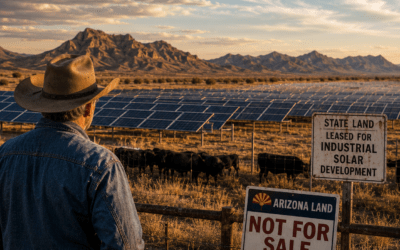
Arizona ratepayers already know what it feels like to watch their electric bills climb. In just the last few years, rates have increased by 27% across Arizona, all while environmentalists and Democrats in Washington claimed that trillions of dollars in subsidies for “renewables” would drive down costs. Unsurprisingly, the opposite has happened.
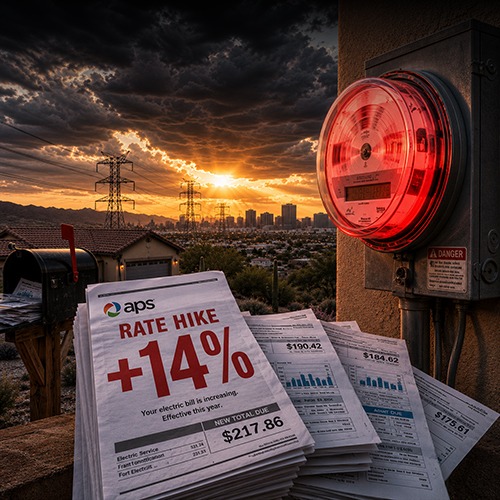
Now, Arizona’s largest monopoly utility, APS, is asking the Arizona Corporation Commission for yet another rate hike. Their double-digit 14% request is bad enough on its own. But buried within APS’ ask is something even worse: automatic rate hikes for the next five years (something the Corporation Commission voted in favor of just a year and a half ago).
It isn’t just APS. At the same time, the Commission is also considering a double-digit (also 14%) rate hike for TEP, along with automatic rate increases. Arizona ratepayers are now seeing the consequences of years of bad energy policy, costly clean energy commitments, and a Commission that has not stopped any of it.
Before APS’ rate request becomes a real rate hike on your bill, the Commission still has to vote on it. Right now, the case is before an administrative law judge, with hearings expected to continue through June and July. After the hearing concludes, the judge will issue a recommended order, and then the Corporation Commission will make the final decision.
So, the question now is simple: will the Commission finally say no, or will it force ratepayers to pay for the Green New Scam?
This Rate Hike Is Not Because of AI or Data Centers
APS, Kris Mayes, and the Corporation Commission would like ratepayers to believe this rate hike is about AI, data centers, and explosive load growth. It isn’t.
Depending on how growth from AI and data centers is managed, it very well could increase costs in the future, but it hasn’t yet. Rate cases lag behind utility investments. The utility spends money then determines it has a revenue deficiency—in other words, that the money it is recovering from ratepayers is not enough to pay its expenses and provide its guaranteed profit—and then applies to the Commission to include those new costs in rates.
This specific case is based on a historic test year: 2024. That may not sound very long ago, but in the age of AI, it was several generations ago, before the grid felt any major increase in electricity demand from data centers.
Look at APS’ peak demand over the last 15 years and compare it to the growth APS is projecting over the next 15 years. In 2010, APS’ peak demand was about 7,000 MW. In 2024, it was just over 8,000 MW. By 2038, APS expects it to be well over 13,000 MW.
Growth is coming. But it has not materialized yet, so it cannot be what is driving this current rate case. Data centers will undoubtedly bring immense demand to the grid, but they will also be paying immensely to get that power. Ideally, they would simply build their own generation. Some data center owners are already doing this around the country. They build the power. They build the lines. They pay all of it. Ratepayers pay nothing. Data centers in this rate case are pushing for the ability to do it here, but the utilities are opposing that effort. The utilities, it seems, would rather build it, sell the power to the data centers, and just give us their word that “growth will pay for growth.”
The Real Cause: Expensive Green Energy Projects
The real cause is much more obvious: expensive Green New Scam projects. We knew this was coming. It is why we opposed APS’ Integrated Resource Plan that was eventually approved by the Corporation Commission in 2024. It is also why we invested in a thorough cost analysis of APS’ plan after the Commission refused to do one itself.
What we found was alarming, but not surprising.
APS’ resource plan, designed to meet its “clean energy commitment,” relied almost exclusively on solar, wind, and battery storage, while shuttering remaining coal generation and building very little new natural gas. The result was a grid with nearly triple the nameplate capacity of today’s system, but less reliable capacity than APS has now.
And the cost? A staggering $42.7 billion, or roughly $100 per month for residential customers. That means ratepayers would be paying far more for a grid that is less reliable. Had APS conducted a true least-cost portfolio, it could have met future demand with far less capacity and at a fraction of the cost. But APS did not do that. And the Commission did not direct them to do it either.
How We Got Here
So how do we get from clean energy promises to double-digit rate hikes? It’s not complicated. In 2020, APS made a clean energy commitment to go 100% clean and carbon-free by 2050. In 2023, APS produced a resource plan to meet that commitment. In 2024, the Corporation Commission approved the plan. APS then used that plan to structure its Request for Proposal process around the same green energy goals.
The RFP required that at least 70% of the resources procured be “clean.” The scoring matrix awarded more points to carbon-free resources. And in the end, APS announced that 93% of the energy contracted for in that RFP was clean.
To put it simply, APS committed to go Net Zero. They wrote a plan to achieve it. They crafted an RFP to deliver it. They contracted for renewables to actualize it. And now, APS is asking ratepayers to pay for it.
To make this real, the single most expensive project APS is seeking recovery for in this rate case is a battery storage facility, called Agave BESS. Compared to natural gas, Agave BESS costs 41% to 92% more. That is why we intervened in this case, why we submitted testimony from two expert witnesses, and why we are actively cross-examining APS’ witnesses. We do not believe ratepayers should bear the costs of radical environmental commitments.
But it might leave people wondering why APS would choose the more expensive option if a lower-cost option was available. The answer was already provided above: APS had already committed itself to green energy, and its executives tied their compensation to keep it going.
APS linked executive compensation to its clean energy goal. It linked executive compensation to capital spending. And because utilities earn a return on capital investment, more spending means higher shareholder returns. In other words, APS executives were incentivized to build more renewables, incentivized to spend more money on them, and incentivized to grow the utility’s capital base.
If the Commission does not say no, ratepayers will pay the price.
The Commission Let This Happen
This did not happen by accident, and it did not happen overnight. The Corporation Commission could have stopped this years ago. They should have shut down the clean energy commitments being adopted by APS and other utilities. They should have demanded a real cost analysis before approving APS’ resource plan. They should have required APS to submit a true least-cost plan. They should have required that every utility conduct a genuinely competitive RFP process. And they should have rejected formula rates before APS and others came asking for automatic rate hikes.
They did none of that.
Now ratepayers are being asked to pay for the consequences. That is why we are in this fight. We are providing evidence and expert testimony to urge the Commission not to make ratepayers pay for imprudent decisions. The Commission didn’t stop the clean energy commitments. They failed to stop the Green New Deal resource plans. They failed to stop the RFP process weighted to build solar, wind and battery storage. They failed to stop the utilities from tying executive compensation to building green energy.
But now they have a chance to stop the rate hikes that flow directly from those decisions.
This should be an easy decision. The Commission should say no to making ratepayers pay for expensive renewables and it must say no to automatic rate hikes.
Help Protect Freedom in Arizona by Joining Our Grassroots Network
Arizona needs to have a unified voice promoting economic freedom and prosperity, and the Free Enterprise Club is committed to making that happen. But we can’t do it alone. We need YOU!
Join our FREE Grassroots Action List to stay up to date on the latest battles against big government and how YOU can help influence crucial bills at the Arizona State Legislature.